

What Is Included in an End-of-Line Packaging System?
Your packaging line should not stop at filling pouches or sealing trays. Finished packs still need to be inspected, counted, grouped, loaded into cases, sealed, labeled and prepared for pallet transportation. When these tasks rely heavily on manual labor, the end of the line can become a bottleneck.
An end-of-line packaging system includes conveyors, inspection equipment, case erectors, product collating systems, case packers, case sealers, palletizers, stretch wrappers and labeling equipment. These machines work together to automate product handling from primary packaging through final shipping preparation.
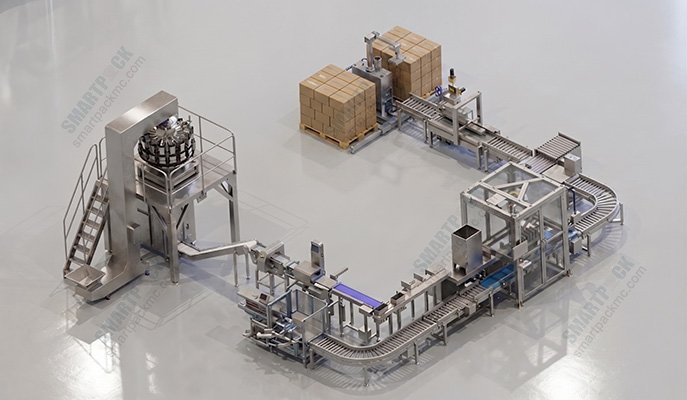
Smartpack has installed over 1,000 packaging systems worldwide. Many manufacturers first automate weighing, filling and primary packaging with VFFS machines or premade pouch packers, but still depend on workers for carton forming, case packing and palletizing. A properly designed end-of-line system helps remove these downstream bottlenecks and improve the efficiency of the complete production line.
What Is an End-of-Line Packaging System?
An end-of-line packaging system refers to the equipment used after primary packaging. It handles product inspection, secondary packaging, case sealing, labeling, palletizing and other processes required before warehousing or shipping.
End-of-line packaging systems can connect directly to VFFS machines, premade pouch packing machines, tray sealers, thermoforming machines, jar filling lines and can packing lines. The exact configuration depends on the package format, production speed, case pattern and required level of automation.
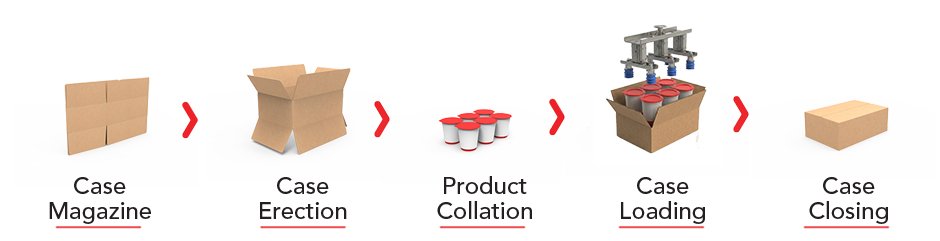
A complete production line normally includes three packaging levels. Primary packaging places the product into a bag, pouch, tray, jar or can. Secondary packaging groups individual packs into cartons or cases for retail distribution and shipping. Tertiary packaging stacks and secures the finished cases on pallets for storage and transportation.
The typical end-of-line process begins when finished packs discharge from the primary packaging machine. Conveyors transfer them through inspection equipment. Approved packs are counted, oriented and grouped into the required case pattern. A case packing machine loads them into cartons, which are then sealed, labeled, palletized and wrapped for transportation.
| Packaging Level | Equipment Examples | Main Purpose |
|---|---|---|
| Primary | VFFS machine, multihead weigher, pouch packer, tray sealer | Packs the individual product |
| Secondary | Case erector, product collator, case packer, case sealer | Groups products for retail or shipping |
| Tertiary | Palletizer, pallet conveyor, stretch wrapper | Prepares cases for storage and transportation |
Not every factory needs every machine. Some manufacturers only need automatic case sealing and palletizing, while others require a complete system from product inspection to finished pallet wrapping.
What Equipment Is Included in an End-of-Line Packaging System?
End-of-line packaging equipment commonly includes conveying, inspection, case forming, product collating, case packing, sealing, labeling and pallet handling systems. Each component performs a specific task while maintaining continuous product flow.
The right equipment should be selected according to the current bottleneck rather than simply adding every available machine.
| Equipment | Main Function | When It Is Needed |
|---|---|---|
| Conveyor and Accumulation System | Transfers and temporarily buffers products | Upstream output fluctuates or packs accumulate |
| Checkweigher and Metal Detector | Checks package weight and possible contamination | Finished packs require automatic quality inspection |
| Case Erector | Opens and forms empty cartons | Manual carton forming cannot keep up with production |
| Product Collating System | Counts, aligns and groups packs | Products require a fixed quantity or case pattern |
| Case Packing Machine | Loads finished packs into cases | Manual loading limits speed or consistency |
| Case Sealer | Closes cartons with tape or hot-melt glue | Consistent automatic sealing is required |
| Labeling and Coding System | Applies labels, barcodes and traceability data | Cases require shipping or production information |
| Robotic Palletizer | Stacks finished cases in programmed patterns | Manual palletizing cannot match line output |
| Stretch Wrapper | Secures completed pallets | Pallets need greater stability during transportation |
Conveyors connect the machines and provide temporary buffering when upstream and downstream speeds do not match. Checkweighers verify package weight, while metal detectors or X-ray systems inspect for possible contamination. Their integrated reject devices remove nonconforming packs without stopping production.
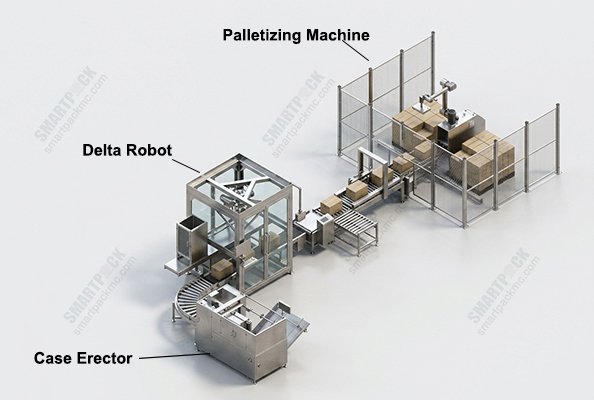
A case erector opens flat cartons and forms the bottom. Before loading, a collating system counts, turns or groups the finished packs into the required pattern. This is especially important for loose pillow bags from VFFS machines.
Case packing machines then load the grouped products into shipping cartons. Top-load systems are commonly used for flexible bags, pouches and trays, while side-load systems can suit boxed products. Delta Robots provide flexible, high-speed picking for one or multiple lanes; mechanical pushers or gantry systems may be more suitable for other products.
After loading, cartons are closed with tape or hot-melt glue and can be labeled with barcodes, batch numbers or shipping data. Robotic palletizers stack the sealed cases in programmed patterns, and stretch wrappers secure the completed pallets for storage and transportation.
Not sure which end-of-line machines your production line needs? Send Smartpack your package type, output speed, packs per case and carton dimensions. Our engineers can recommend a suitable configuration and preliminary layout.
How Do End-of-Line Systems Work Together in a Packaging Line?
Individual machines do not automatically form an efficient end-of-line system. The speed, timing and controls of every module must be coordinated to prevent product accumulation and frequent line stops.
An integrated end-of-line system uses centralized controls to coordinate product flow, equipment timing, accumulation and changeovers from the primary packaging machine to the finished pallet.
For example, if a VFFS machine produces 120 bags per minute and each carton contains six bags, the downstream system must form, collate, load and seal approximately 20 cases per minute. The conveyor, checkweigher, case erector and case packer must all support this requirement with suitable reserve capacity.
A centralized control system coordinates the machines. When the case packing section temporarily slows down, an accumulation conveyor holds the products. Once the downstream section is ready, the system releases them in a controlled manner.
The main control panel can display machine status, alarms and production information. Remote diagnostics and data collection can also be added when required.
Factories can choose from three common automation paths:
-
Case Sealing and Palletizing
Suitable for factories that still load products into cases manually but want to automate case sealing, conveying and pallet stacking. -
Automatic Case Packing
Adds case erecting, product counting and grouping, robotic loading and automatic sealing when manual case packing cannot keep up with the primary packaging machine. -
Complete End-of-Line Automation
Integrates inspection, accumulation, case erecting, product collating, case packing, sealing, labeling, palletizing and stretch wrapping into one coordinated system.
This step-by-step approach allows manufacturers to solve the most urgent bottleneck first while reserving space and interfaces for future expansion.
Industries That Commonly Use End-of-Line Packaging Automation
End-of-line automation is widely used in snack food, frozen food, ready meal, pet food, meat, bakery, confectionery and other packaged food industries. However, the equipment configuration should reflect the product and package characteristics.
Each industry requires a different combination of product handling, environmental protection, case packing and palletizing technology.
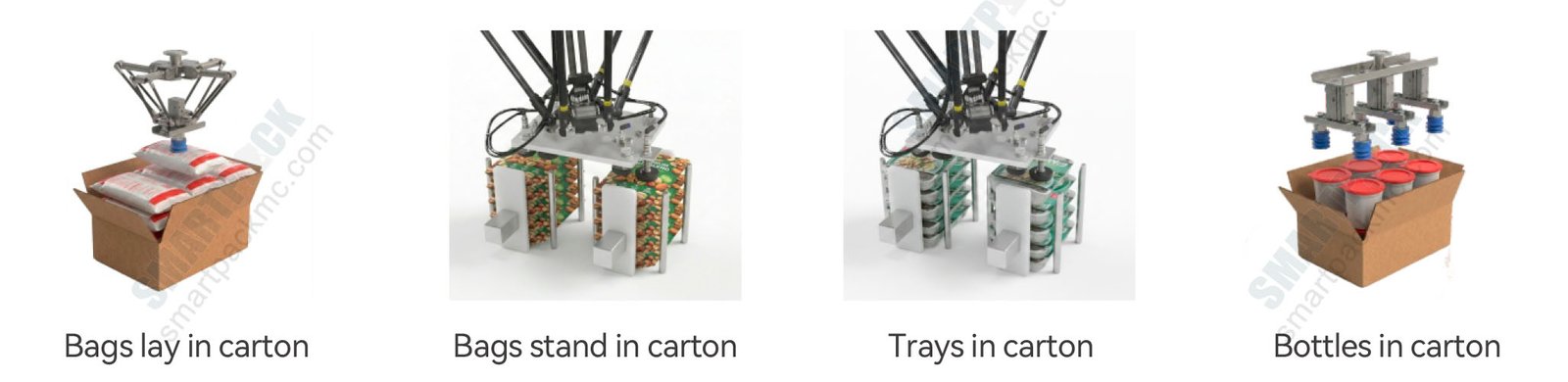
Snack food lines often handle lightweight pillow bags at high speed. Fragile snacks require gentle conveying and controlled loading to reduce crushing and maintain stable case arrangements.
Frozen food operations may require moisture-resistant components, washable surfaces and equipment suitable for low-temperature or humid environments. The design should also maintain reliable labeling and carton handling.
Ready meal lines require careful tray collating and loading to prevent deformation, label damage or leakage. Vision inspection can verify tray orientation and label position.
Pet food lines may handle pouches, cans, jars or larger bags. The grouping, case packing and palletizing equipment should match package rigidity, weight and case pattern.
Smartpack customizes each system for the product, primary package, carton format, production speed and available factory layout instead of applying the same standard configuration to every production line.
Benefits of End-of-Line Packaging Automation
The main value of end-of-line automation is not simply replacing individual workers. It enables downstream packaging to operate at a speed and consistency that better match the primary packaging equipment.
End-of-line automation reduces dependence on repetitive manual handling, improves packing consistency, removes downstream bottlenecks and creates a more scalable production process.
Key benefits include:
- Reduced dependence on repetitive manual handling
- More consistent case quantities and packing patterns
- Stable carton sealing and labeling quality
- Fewer product backups between primary and secondary packaging
- Better pallet stability during storage and transportation
- Easier production monitoring and fault diagnosis
- Greater flexibility for future capacity expansion
Actual labor reduction and investment payback depend on the existing process, local labor costs, speed, shifts and automation scope. They should be calculated using the manufacturer's real production data rather than a fixed industry estimate.
Smartpack's end-of-line systems offer three main advantages:
-
Complete EOL Automation
Case erecting, packing, sealing and palletizing. -
Flexible Customization
Adapts to different packs, cartons and speeds. -
Higher Efficiency
Increases output while reducing labor.
How to Choose the Right End-of-Line Packaging System
The correct system should be designed around the complete packaging flow rather than selected as a group of separate machines.
Choose end-of-line equipment based on the product, package format, actual line speed, case arrangement, available space and future expansion plans.
Product characteristics determine how packs should be conveyed and loaded. Fragile bags need gentle handling, heavy products require stronger structures and higher robot payloads, and rigid trays, cans, jars and pouches require different grouping methods.
Production speed must be based on the real output of the primary packaging machine. Downstream equipment should accommodate short-term fluctuations and planned capacity increases without being unnecessarily oversized.
Before requesting a proposal, prepare the following information:
- Product and package type
- Package dimensions and weight
- Primary packaging machine and output speed
- Number of packs per carton
- Carton dimensions
- Required packing pattern
- Case sealing method
- Pallet size and stacking height
- Available factory floor space
- Future product or packaging formats
Whenever possible, provide product, package and carton samples for testing. The layout should also show operator access, maintenance space, material flow and possible expansion areas.
Get a Free End-of-Line Layout
Share your existing packaging machine, bag or tray size, output speed, packs per carton and available floor space. Smartpack engineers can prepare a customized equipment recommendation and preliminary layout.
Why Are More Manufacturers Moving Toward Fully Automated Packaging Lines?
Many factories first automate weighing, filling and primary packaging because these processes directly affect output and package quality. As upstream speed increases, however, manual case packing and palletizing often become the next bottlenecks.
A fully integrated packaging line coordinates primary packaging, inspection, case packing and palletizing as one process, helping manufacturers improve the balance and scalability of the entire line.
Adding workers may temporarily increase downstream capacity, but it does not always provide stable output across multiple shifts or seasonal peaks. Automation makes capacity less dependent on repetitive manual tasks.
Integrated controls also make it easier to identify where products accumulate, which machine causes repeated stops and how long changeovers take.
For factories with multiple packaging machines, several primary lines can feed one centralized case packing or palletizing system when the formats, combined output and schedules allow it.
The industry is therefore moving from isolated machines toward coordinated solutions. The objective is not to automate every process at once, but to remove the bottlenecks that limit total line performance and build a system that can support future products and higher output.
Conclusion
An end-of-line packaging system can include conveyors, inspection equipment, case erectors, product collating systems, case packers, case sealers, labeling systems, palletizers and stretch wrappers.
The right configuration depends on what happens after the product leaves the primary packaging machine. Some factories only need automatic case sealing and palletizing, while others require complete automation from product inspection to finished pallet wrapping.
Smartpack provides customized end-of-line automation for different products, packaging formats, carton arrangements and production speeds. Our systems can integrate automatic case erecting, Delta Robot case packing, case sealing and robotic palletizing into one coordinated packaging line.
To receive a suitable proposal, send us your package specifications, line speed, carton format and factory layout. Our engineers will help identify the current bottleneck and design an end-of-line system that supports both present production and future expansion.