

Your primary packaging runs at 140 bags per minute, but your secondary packing can't keep up. This bottleneck costs you thousands in lost productivity daily.
Secondary packaging machine automation integrates case packing, palletizing, and inspection systems to eliminate end-of-line bottlenecks. Modern food manufacturers achieve 30-40% labor reduction and 25% higher OEE through complete automated solutions.
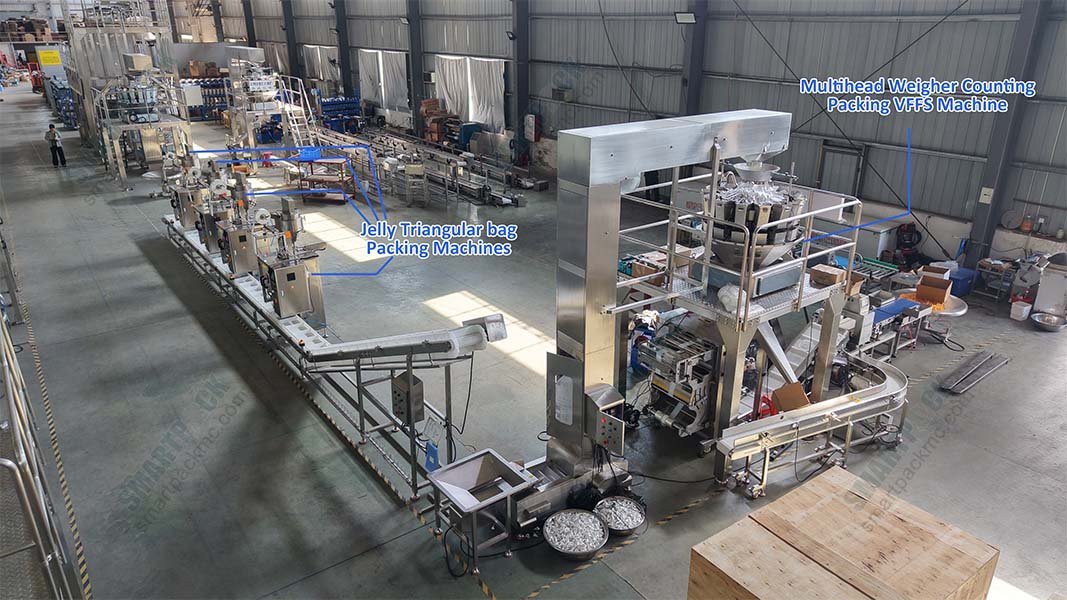
Smartpack has observed this scenario countless times in our client facilities. A snack manufacturer invests heavily in high-speed multihead weighers and twin VFFS systems, only to watch finished bags accumulate because manual operators can't match the upstream production speed. This creates the exact problem you want to avoid.
Why Are Manual Secondary Packing Operations Creating Production Bottlenecks?
Your packaging machines have become incredibly fast. But your secondary packing still relies on manual labor that simply can't keep pace.
Manual secondary packing creates bottlenecks because modern packaging lines produce 100-200 bags per minute while operators handle 30-50 bags per minute maximum. This speed mismatch causes accumulation, downtime, and inconsistent production flow.
Smartpack recently worked with a frozen vegetable manufacturer facing exactly this challenge. Their 16-head multihead weigher and VFFS system produced 120 bags per minute consistently. But three operators could only manage case packing at 45 bags per minute during peak performance.
Here's what our team discovered about their production losses:
| Production Issue | Manual Operations | Automated Solution |
|---|---|---|
| Average Speed | 45 bags/minute | 120+ bags/minute |
| Downtime Events | 8-12 per shift | 1-2 per shift |
| Quality Consistency | Variable | Consistent |
| Labor Requirements | 3 operators | 0.5 operator |
| Line Efficiency | 65% | 92% |
The core problem isn't just speed. Manual secondary packing creates multiple failure points. Operators get tired, bags accumulate unevenly, carton loading becomes inconsistent, and production stops whenever someone takes a break. Smartpack sees this pattern repeatedly across different food categories. Beyond speed limitations, manual operations suffer from quality inconsistencies. When operators rush to keep up with high-speed primary packaging, carton loading becomes uneven, bags get damaged, and packing patterns vary between shifts. This creates downstream problems in warehousing and transportation. Smartpack has documented cases where manual secondary packing caused 15-20% more product damage during shipping compared to automated systems. The labor shortage crisis makes these issues even more critical. Food manufacturers struggle to find and retain skilled packaging operators, leading to constant training costs and production interruptions when experienced workers leave.
Modern Packaging Speed Requirements
Today's food manufacturers face increasing pressure to maximize line efficiency. Primary packaging equipment has evolved dramatically:
- Multihead weighers: 24-head systems reaching 200+ weighments per minute
- VFFS machines: Twin systems producing 140-180 bags per minute
- Premade pouch systems: High-speed lines exceeding 100 pouches per minute
But secondary packing often uses the same manual approaches from 20 years ago. This creates an immediate bottleneck that limits your entire production capability. The economics become clear when you calculate lost revenue from this speed mismatch over time.
What Equipment Components Make Up an Automated Secondary Packaging System?
Secondary packaging automation isn't a single machine. It's an integrated system that handles finished bags from your primary packaging line through warehouse-ready pallets.
Complete secondary packaging systems include checkweighers, metal detectors, bag arranging equipment, automatic case packers, carton sealers, and robotic palletizers. Each component works together to maintain continuous production flow.
Let Smartpack walk you through each system component based on our typical installations. Understanding how these machines work together helps you see why integration matters more than individual equipment specifications.
Essential System Components
| Component | Function | Key Benefits | Typical Speed Range |
|---|---|---|---|
| Checkweigher | Weight verification, reject handling | Quality control, giveaway reduction | 200+ packages/minute |
| Metal Detector | Foreign object detection | Food safety compliance | 150+ packages/minute |
| Bag Arranging | Counting, grouping, orientation | Stable case packing feed | 120+ bags/minute |
| Case Packer | Automatic bag loading into cartons | Labor reduction, consistency | 15-30 cartons/minute |
| Carton Sealer | Tape or glue sealing | Secure packaging | 20-35 cartons/minute |
| Robotic Palletizer | Automated stacking | Warehouse-ready output | 8-12 cases/minute |
Checkweigher and Inspection Systems
Every secondary packaging line Smartpack designs includes inline inspection. The checkweigher verifies target weight compliance and rejects underweight packages before they reach cartons. This prevents short-weight cartons from reaching customers. Metal detection is equally critical, especially for export markets. Smartpack integrates these systems into the conveyor flow so rejected products automatically divert without stopping production. Our checkweighers can handle speeds up to 200+ packages per minute with ±0.5g accuracy for most food products. The system automatically tracks reject rates and weight distribution data, helping manufacturers optimize their upstream weighing accuracy. For frozen food applications, we design moisture-resistant checkweighers with heated load cells to prevent condensation issues. The metal detection systems use advanced digital signal processing to detect ferrous, non-ferrous, and stainless steel contaminants as small as 0.8mm in typical food packaging.
Automatic Bag Arranging Systems
This is where many manufacturers underestimate complexity. Finished bags need counting, grouping, alignment, and sometimes rotation before entering case packers. Without proper bag organization, you get carton jams, unstable loading, and bag deformation. Smartpack recalls one potato chip manufacturer who initially skipped the bag arranging system to save costs. Within two weeks, they called our team back because their case packer couldn't handle randomly oriented bags at production speed. Our bag arranging systems use servo-driven mechanisms to precisely control bag positioning. For flexible packages like chips or salads, we incorporate gentle handling to prevent product damage. The system can automatically adjust for different bag sizes within preset parameters, making changeovers faster and more reliable. Vision systems verify proper bag orientation and count accuracy before release to the case packer. This eliminates the most common cause of case packer jams and ensures consistent carton loading patterns.
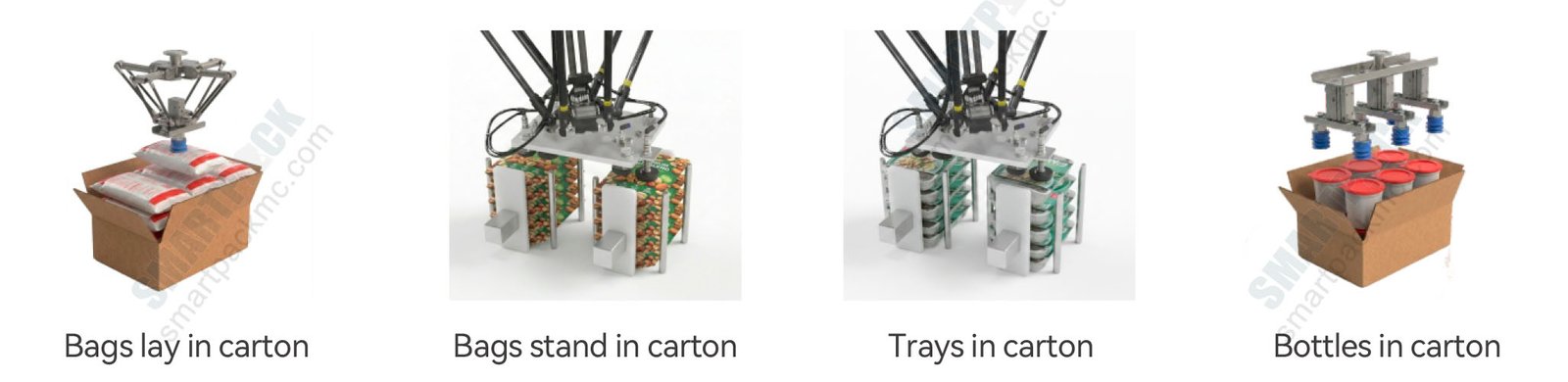
Case Packing Solutions
Smartpack offers different case packing approaches depending on your product characteristics:
- Robotic pick-and-place: Best for rigid bags, precise placement
- Top-load systems: High speed for flexible bags
- Side-load packers: Excellent for fragile products
- Wraparound systems: Cost-effective for simple carton styles
Robotic Palletizing Integration
Palletizing represents the final automation step. Smartpack's robotic systems handle carton stacking with consistent pallet patterns. This eliminates manual lifting, improves workplace safety, and ensures warehouse-ready pallet quality. Our robotic palletizers can handle various carton sizes and weights up to 25kg per case. The system includes automatic pallet dispensing, layer sheet insertion, and pallet wrapping integration. Advanced software optimizes stacking patterns for maximum pallet stability and warehouse efficiency. The robots work continuously without breaks, maintaining consistent throughput even during shift changes. For food safety applications, we provide stainless steel robot arms and wash-down compatible control panels.
What Are the Main Benefits of Integrated Secondary Packaging Automation?
Automated secondary packaging delivers measurable improvements beyond just eliminating manual labor. The real value comes from total line optimization and operational consistency.
Integrated secondary packaging automation reduces labor costs by 60-75%, increases line efficiency by 25-35%, improves packaging quality consistency by 90%, and provides 18-24 month ROI for most food manufacturers.
Smartpack has tracked performance data from over 300 secondary packaging installations across different food categories. The results consistently show that integrated automation delivers superior returns compared to standalone equipment purchases.
Quantified Performance Improvements
| Benefit Category | Manual Operations | Automated Systems | Improvement |
|---|---|---|---|
| Labor Requirements | 3-4 operators/shift | 0.5-1 operator/shift | 70% reduction |
| Line Efficiency (OEE) | 65-75% | 85-95% | 25% improvement |
| Packaging Quality | Variable | Consistent | 90% less variation |
| Product Damage | 2-3% | 0.5-1% | 60% reduction |
| Changeover Time | 30-45 minutes | 5-15 minutes | 75% reduction |
| Annual Maintenance | High variability | Predictable | 40% cost reduction |
The labor savings alone typically justify automation investments within 18-24 months for most food manufacturers. But the additional benefits from improved efficiency, reduced waste, and better quality control accelerate the payback period significantly. Smartpack's clients report that automation helps them handle seasonal demand spikes without temporary labor hiring, which can be expensive and unreliable. The systems also enable lights-out production during off-hours, effectively adding production capacity without facility expansion. Quality improvements reduce customer complaints and returns, protecting brand reputation while lowering replacement costs. Consistent packaging also improves warehouse efficiency and reduces transportation damage, creating additional cost savings throughout the supply chain.
How Should You Choose the Right Secondary Packaging Automation Solution?
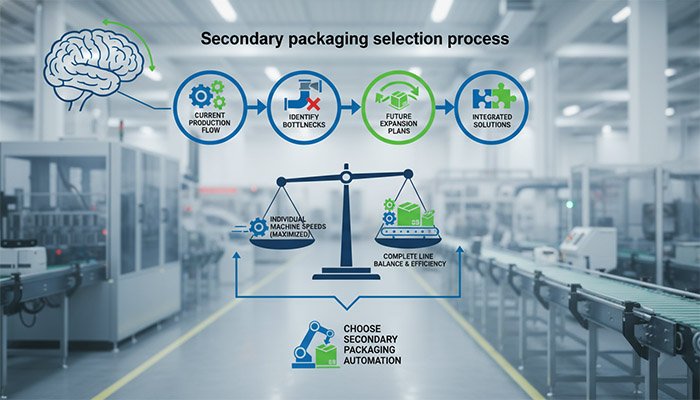
Selecting secondary packaging automation requires evaluating your entire production workflow, not individual machines. The wrong approach leads to expensive equipment that doesn't solve your actual bottlenecks.
Choose secondary packaging automation by analyzing current production flow, identifying specific bottlenecks, evaluating future expansion plans, and selecting integrated solutions that balance your complete line rather than maximizing individual machine speeds.
Smartpack has helped over 200 food manufacturers implement secondary packaging automation. The most successful projects follow a systematic evaluation approach that considers both immediate needs and future growth.
Evaluation Framework
| Evaluation Factor | Key Questions | Impact on Selection |
|---|---|---|
| Current Production | What's your actual bottleneck speed? | Determines required automation speed |
| Product Characteristics | Bag type, size variations, fragility? | Influences handling system design |
| Facility Constraints | Available space, ceiling height? | Affects equipment configuration |
| Future Plans | Production growth, new products? | Ensures scalable solution |
| Integration Requirements | Upstream/downstream equipment? | Determines interface complexity |
| Budget Considerations | Capital available, ROI expectations? | Guides automation level selection |
Start With Production Flow Analysis
Don't begin by shopping for case packers or palletizers. Start by mapping your complete production workflow from weighing through warehouse storage. This reveals where bottlenecks actually occur and what automation will deliver real impact. Smartpack worked with a confectionery manufacturer who thought they needed a faster case packer. After analyzing their line, our team discovered the real bottleneck was inconsistent bag feeding from their primary packaging. Smartpack solved their problem with a bag accumulation system that cost 60% less than the case packer upgrade they originally considered. This comprehensive analysis approach helps manufacturers avoid expensive mistakes and focus investment where it delivers maximum benefit. Our engineers use time-motion studies and production data analysis to identify hidden inefficiencies that manufacturers might miss. Sometimes the solution involves optimizing existing equipment interfaces rather than adding new automation. We also evaluate downstream requirements to ensure the secondary packaging system produces warehouse-compatible outputs.
Consider Scalable Automation Approaches
Many manufacturers implement secondary packaging automation in phases. You might start with semi-automatic case packing, then add robotic palletizing, then integrate complete line control systems. Smartpack's modular designs support this graduated approach. The initial system includes interfaces and space provisions for future automation additions. This lets you spread capital investment while ensuring compatibility. We design systems with standardized communication protocols and modular conveyor sections that accommodate future expansion without major reconstruction. The control systems use scalable PLC platforms that can integrate additional equipment seamlessly. This phased approach helps manufacturers validate automation benefits before committing to complete line automation, reducing financial risk while building operational confidence.
Conclusion
Secondary packaging automation transforms your production bottleneck into a competitive advantage through integrated systems that eliminate manual labor dependencies while delivering measurable improvements in efficiency, quality, and profitability.