

A fast VFFS machine can still create a slow line when bag handling, case packing, or palletizing cannot keep up.
A practical snack packaging line layout connects feeding, weighing, VFFS bagging, inspection, bag handling, case packing, case sealing, robotic palletizing, and pallet wrapping. The best layout balances speed, floor space, bag stability, case output, and finished pallet flow.
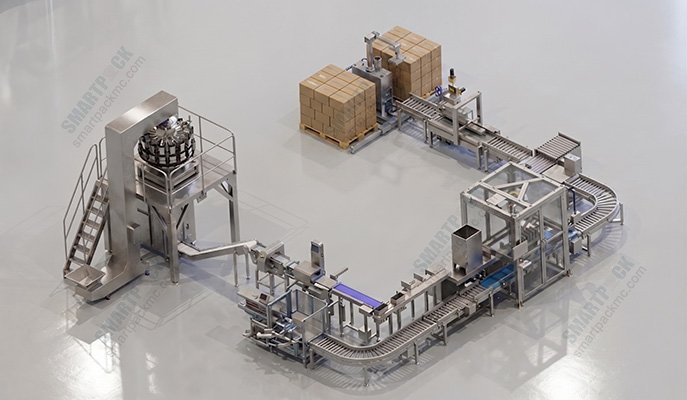
Snack packaging line design is not only a machine selection task. It is a system design task. Chips, popcorn, puffed snacks, nuts, candy, and other pillow bag products all move differently through conveyors, inspection systems, case packers, and palletizers. A line that looks simple on a drawing may run poorly if one transfer point, one buffer section, or one case pattern is wrong.
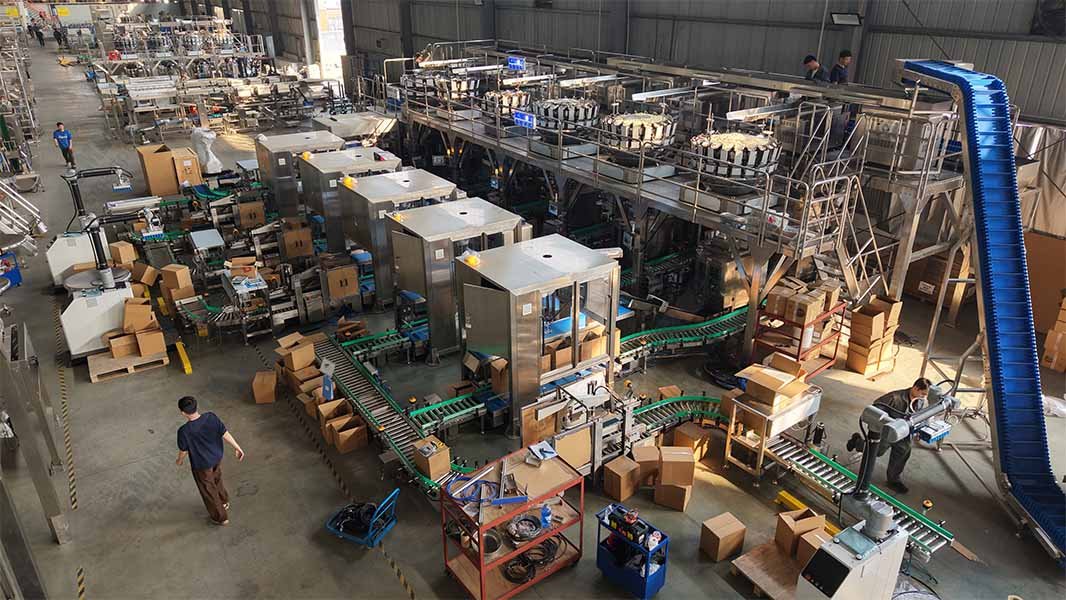
Smartpack has already provided fully automatic packing line solutions for 10+ customers, including systems with auto cartoning by delta robot and palletizing machines. These projects show one clear point: the full layout should be planned from VFFS bagging to finished pallet discharge, not only around one fast machine.
What Does a Complete Snack Packaging Line Layout Include?
Many snack lines lose output after the VFFS machine. The problem often starts when primary packaging, case packing, and palletizing are planned separately.
A complete snack packaging line usually includes product feeding, multihead weighing, VFFS bagging, date coding, checkweighing, metal detection, bag discharge, accumulation, case erecting, case packing, case sealing, robotic palletizing, and stretch wrapping.
Main Sections of the Line
A typical automated snack packaging line can be divided into three main sections: primary packaging, secondary packaging, and end-of-line palletizing.
The complete product flow often looks like this:
Product feeding → Multihead weigher → VFFS machine → Date coding → Checkweigher / metal detector → Bag discharge and orientation → Accumulation conveyor → Case erector → Case packing or auto cartoning → Case sealing → Case labeling or inspection → Robotic palletizing → Stretch wrapping
| Line Section | Common Equipment | Main Function |
|---|---|---|
| Primary packaging | Elevator, multihead weigher, VFFS machine | Feed, weigh, form, fill, seal, and cut bags |
| Inspection and bag handling | Printer, checkweigher, metal detector, reject conveyor, spacing conveyor | Check quality and control bag flow |
| Secondary packaging | Case erector, case packer, auto cartoning system, case sealer, labeler | Load finished bags into corrugated cases or cartons |
| End-of-line palletizing | Robotic palletizer, pallet conveyor, stretch wrapper | Stack sealed cases and prepare finished pallets |
Not every factory needs all of these machines at the beginning. A small snack factory may start with a VFFS machine and manual case packing. A larger factory may need a fully automatic line that connects VFFS bagging directly with case packing, auto cartoning, and robotic palletizing.
Why Each Section Should Be Planned Together
A high-speed VFFS machine does not create high output by itself. The inspection, bag handling, case packing, and palletizing sections must accept the bag flow without damaging the product or creating frequent stops.
For snack products, the VFFS section may also include nitrogen flushing, date coding, batch printing, hole punching, easy-open devices, gusseting, and film tracking. These options affect bag shape, bag stability, and downstream handling.
Fragile snacks need special attention. Potato chips, popcorn, and puffed snacks can break during high drops or rough transfers. Nitrogen-filled bags can be bulky and unstable after sealing. For this reason, transfer height, drop distance, product timing, bag discharge, and accumulation design should be reviewed before the final line layout is confirmed.
In Smartpack projects, the most stable automatic lines are usually the ones where weighing, bagging, inspection, auto cartoning by delta robot, case sealing, and palletizing are designed as one connected system. This avoids the common problem where each machine runs well alone, but the full line does not run smoothly together.
How Should Product Type, Bag Size, and Target Speed Guide the Layout?
A layout should start with the product and the finished bag. If the product behavior is ignored, the line may need costly changes after installation.
Product type, target weight, bag style, bag size, required speed, bags per case, case size, case weight, SKU range, and pallet flow should be clear before equipment selection.

Product Behavior Comes First
Different snack products behave differently inside the line. Potato chips are bulky and fragile. Nuts are dense and stable. Popcorn is light and takes up more space. Puffed snacks may be fragile and nitrogen-filled. Small snack packs may require much higher bag-per-minute output.
| Product Type | Bag Behavior | Layout Concern | Design Focus |
|---|---|---|---|
| Potato chips | Bulky, fragile, often nitrogen-filled | Breakage and unstable bag shape | Gentle transfer, low drop height, controlled compression |
| Popcorn | Light and bulky | Large bag volume and low case density | Proper case size and smooth bag handling |
| Nuts | Dense and more stable | Higher case weight | Strong case handling and accurate weighing |
| Puffed snacks | Fragile and inflated | Bag deformation and air volume | Gentle loading and enough accumulation |
| Small snack packs | Small pillow bags and high quantity | High bags-per-minute demand | Fast counting and stable collation |
Bag size also affects the layout. A large pillow bag for chips needs more conveyor space and larger cases. A small pouch for nuts may allow a more compact case packing system. If the same line handles many SKUs, the layout should allow adjustment for different bag lengths, bag widths, case counts, and case sizes.
Target Speed Changes the Whole Layout
A line designed for 40 bags per minute can be much simpler than a line designed for 120 bags per minute. At higher speeds, bag orientation, accumulation, case packing cycle time, and robotic palletizing capacity become much more important.
Before choosing the layout, these questions should be answered:
- What product will be packed?
- What is the target weight per bag?
- What is the bag style and size range?
- How many bags per minute are required?
- How many bags go into each case?
- What is the case size and case weight?
- How many cases per minute must be handled?
- Will one line run one SKU or many SKUs?
- Will multiple VFFS machines feed one case packing area?
- Will the line use auto cartoning by delta robot?
- How will finished pallets leave the line?
When these details are clear, the equipment layout becomes easier to design. The risk of mismatched equipment also becomes much lower.
How Is Case Packing Speed Calculated After VFFS?
One common layout mistake is focusing only on VFFS speed. The real output depends on whether downstream equipment can handle the bag flow.
Required case packing speed equals VFFS bags per minute divided by bags per case. Extra capacity should be added for rejects, short stops, unstable spacing, changeover, and palletizing demand.
Basic Speed Formula
The basic formula is simple:
Required case packing speed = VFFS bags per minute ÷ Bags per case
For example, if a VFFS machine produces 80 bags per minute, and each case contains 10 bags, then the required case packing speed is:
80 ÷ 10 = 8 cases per minute
This number is only the theoretical speed. In real production, the case packer should usually have extra capacity. The line also needs to consider reject rate, short stops, bag spacing instability, operator intervention, SKU changeover, and downstream accumulation.
| VFFS Speed | Bags per Case | Theoretical Case Speed | Recommended Case Packer Capacity |
|---|---|---|---|
| 60 bags/min | 10 bags/case | 6 cases/min | 7–8 cases/min |
| 80 bags/min | 10 bags/case | 8 cases/min | 9–10 cases/min |
| 100 bags/min | 12 bags/case | 8.3 cases/min | Around 10 cases/min |
| 120 bags/min | 12 bags/case | 10 cases/min | Around 12 cases/min |
Robotic Palletizing Capacity Should Match Case Output
This calculation also affects robotic palletizing. If the case packer outputs 10 cases per minute, the palletizing system must receive, orient, and stack at least 10 cases per minute. If one robotic palletizer handles multiple packaging lines, the combined case output of all lines must be calculated.
A balanced line should have:
- Enough downstream capacity
- Enough accumulation between key sections
- Stable bag spacing and orientation
- Reasonable safety margin in case packing speed
- Palletizing capacity matched to actual case output
- Operator access during stops and recovery
The goal is to avoid a line where the VFFS machine runs fast, but case packing, auto cartoning, or palletizing becomes the bottleneck. The best layout is not only fast at one point. It should stay stable across the full production shift.
For projects that include delta robot cartoning, speed calculation should also include robot picking rate, bag arrival spacing, carton indexing time, and reject handling. If the palletizing machine is connected directly after case sealing, its real cycle capacity should be checked together with the upstream cartoning output.
How Can the Right Factory Layout Be Selected?
There is no single layout that fits every snack factory. Floor space, product flow, operator access, and finished goods movement all affect the final choice.
Common layout options include straight-line, L-shaped, U-shaped, and multi-line feeding layouts. The best choice depends on workshop space, VFFS quantity, automation level, SKU range, and warehouse flow.
Straight-Line Layout
A straight-line layout is the simplest and most common design for one VFFS line.
The flow is usually:
VFFS machine → Inspection → Accumulation → Case packing or auto cartoning → Case sealing → Robotic palletizing
This layout is easy to understand, easy to operate, and easy to maintain. Operators can follow the product flow from the VFFS section to the palletizing section. Inspection, cleaning, and troubleshooting are also more direct.
A straight-line layout is suitable for:
- One VFFS packaging line
- Long workshop space
- Clear product flow direction
- Stable product and case format
- Simple operator management
The main limitation is floor length. If the factory has limited space, a straight line may become too long. In that case, the case packing and palletizing sections may need to turn at 90 degrees or be arranged in a more compact shape.
L-Shaped or U-Shaped Layout
An L-shaped or U-shaped layout is useful when the workshop is not long enough for a straight line. It can also keep operators closer to the main working area.
In this design, the VFFS machine may discharge bags toward an accumulation conveyor. The product flow then turns toward the case packing area. Sealed cases may move toward a robotic palletizing cell placed near the warehouse or finished goods area.
| Layout Type | Suitable Situation | Main Design Concern |
|---|---|---|
| Straight-line | Long space and one clear product flow | Floor length |
| L-shaped | Limited length and fixed building direction | Bag control during turns |
| U-shaped | Compact production area | Operator and maintenance access |
| Multi-line feeding | Several VFFS machines feeding one end-of-line area | Capacity balance and accumulation |
The key challenge in L-shaped or U-shaped layouts is bag control. Pillow bags can rotate or shift during conveyor turns. If the bag orientation changes too much before case packing, the case packer may not load bags accurately.
For L-shaped or U-shaped layouts, the design should pay attention to conveyor turning radius, bag spacing, bag orientation, transfer height, accumulation length, operator access, maintenance space, and safety guarding around the palletizing area.
Multiple VFFS Lines Feeding One Case Packing Area
Many snack factories operate more than one VFFS machine. Two or three VFFS machines may run different bag sizes or different flavors. In this case, the factory may want to connect multiple VFFS lines to one shared case packing and palletizing area.
This can be efficient, but it requires careful planning. A shared case packing area may be suitable when multiple VFFS lines have similar bag sizes, similar case counts, and similar running conditions. The case packer or delta robot cartoning system must have enough flexibility. The layout must also provide enough accumulation. The robotic palletizing system must handle the combined case output.
If the products, bag sizes, case sizes, or output speeds are very different, separate case packing systems may be more stable. A multi-line layout can save labor and centralize end-of-line automation, but it should be designed around real production demand, not only equipment cost.
Smartpack has experience in fully automatic packing line projects where several upstream packaging machines connect with automatic cartoning and palletizing. In these projects, the most important design point is not only how many machines are used. The more important point is whether the shared downstream area can handle real peak output without blocking the VFFS lines.
How Should the Case Packing System Be Chosen for Snack Pillow Bags?
Case packing is one of the most important decisions in a snack packaging line. Soft pillow bags can deform, shift, or overlap during transfer.
Case packing options include manual packing, semi-automatic packing, mechanical packing, robotic case packing, and delta robot case packing. The right choice depends on speed, bag type, fragility, labor cost, case count, and SKU flexibility.
Case Packing Methods for Snack Bags
For VFFS pillow bags, the case packing system must handle soft, flexible bags gently and consistently. This is especially important for nitrogen-filled chips, puffed snacks, and other bulky snack bags.
| Case Packing Method | Suitable For | Limitations |
|---|---|---|
| Manual case packing | Low-speed lines, startup factories, trial production | Labor cost, inconsistent quality, limited speed |
| Semi-automatic case packing | Medium output and limited budget | Still requires operator involvement |
| Mechanical case packing | Stable product, fixed bag size, fixed case count | Less flexible for frequent SKU changes |
| Robotic case packing | Multi-SKU snack lines, fragile pillow bags, flexible case counts | Higher initial investment |
| Delta robot case packing / auto cartoning | Lightweight pillow bags, high-speed pick-and-place, carton loading | Requires stable bag spacing and orientation |
Manual packing may be enough for low-volume production. It is simple and flexible, but it depends heavily on labor. As output grows, manual packing can become expensive and inconsistent.
Semi-automatic case packing can reduce labor while keeping the system relatively simple. It may still require operators to place cases, arrange products, or assist with loading.
Mechanical case packing is efficient when product and case format are stable. It can be a good choice for high-volume production with limited SKU changes. If the factory changes bag sizes or case counts often, a mechanical system may require longer changeover time.
Robotic case packing is often suitable for snack pillow bags because it can handle different bag patterns and product formats more flexibly. With the right gripper and vision or tracking system, a robot can pick bags and place them into cases gently.
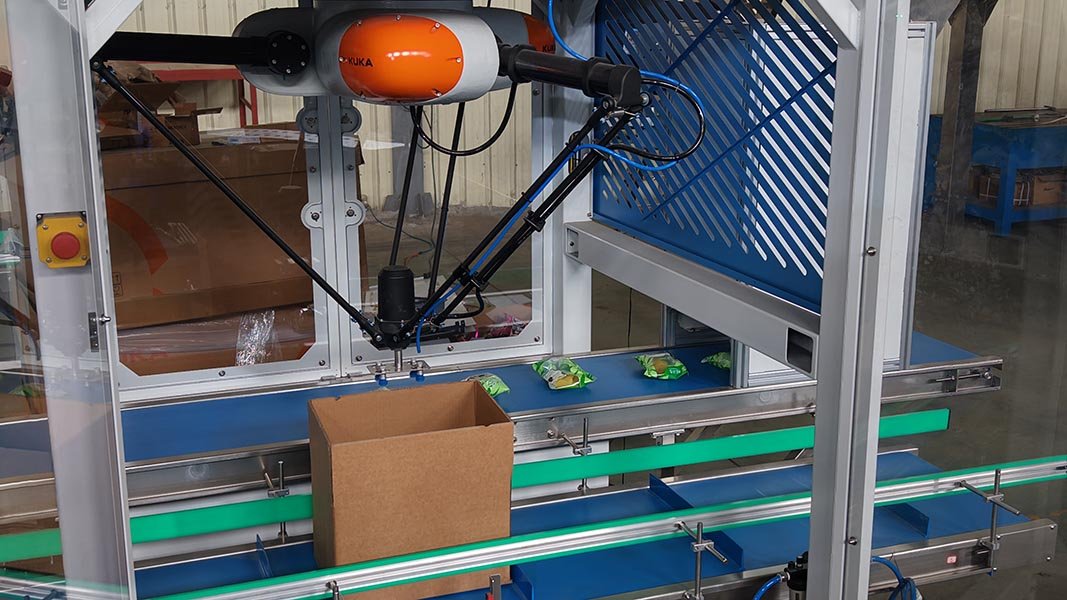
Delta robot case packing can be used for lightweight snack bags when high-speed picking is required. It needs stable bag spacing and orientation from the upstream conveyor. If the bags arrive randomly, the system will need additional control, vision, or alignment.
Smartpack has provided automatic cartoning solutions by delta robot for customers who needed faster bag collation and more stable carton loading. In these systems, the delta robot does not work alone. It works with bag spacing conveyors, tracking control, carton forming or indexing, reject handling, case sealing, and palletizing machines. This complete design helps the line reduce labor and keep output more stable.
Flat Case Loading Pattern for VFFS Pillow Bags
For most snack pillow bags produced by VFFS machines, the bags are loaded flat into corrugated cases rather than standing upright.
This is especially common for chips, puffed snacks, popcorn, and other flexible snack bags. The pillow bag shape is usually soft and inflated, so flat loading helps improve stability and reduce the risk of product damage.
For VFFS pillow bags, case pattern design is usually about:
- How many bags per case
- How many bags per layer
- How many layers per case
- Bag direction inside the case
- Whether the direction alternates by layer
- How much compression is acceptable
- Whether the bag shape changes after nitrogen flushing
- How gently the bags can be placed into the case
For fragile snacks, the system should avoid excessive pressing, high drop height, and unstable stacking inside the case. A case that is too tight may crush the product or deform the bag. A case that is too large may reduce pallet stability and increase shipping cost.
Case size should be confirmed with real bag samples whenever possible. The actual filled bag may behave differently from its theoretical dimensions, especially when nitrogen flushing is used.
What Bottlenecks and Layout Mistakes Should Be Avoided?
A snack packaging line may look good on a drawing but still perform poorly after installation. Many problems come from layout details that were missed early.
Common bottlenecks include low downstream capacity, no accumulation, poor pillow bag orientation, high drop height, early case size confirmation, poor pallet flow, and limited maintenance space.
Common Bottlenecks in Real Production
A fast VFFS machine does not guarantee high line output. If the VFFS machine produces 100 bags per minute but the case packing system can only handle 70 bags per minute, the line will stop frequently. The same problem can happen if the case packer is fast enough but the palletizing system cannot keep up with the case output.
| Bottleneck or Mistake | What Usually Happens | Better Layout Practice |
|---|---|---|
| VFFS speed is higher than downstream speed | Frequent stops after bagging | Match case packing and palletizing capacity |
| No accumulation between VFFS and case packing | Any short downstream stop stops the VFFS machine | Add proper buffer conveyors |
| Pillow bags are not oriented | Missed picks and wrong case loading | Add spacing, alignment, and orientation control |
| Bag drop height is too high | More broken snacks | Reduce unnecessary drops and use smooth transfers |
| Case size is confirmed too early | Bags are crushed or cases waste space | Test with real filled bags |
| Palletizing ignores warehouse flow | Extra forklift movement and handling | Plan empty pallet infeed and full pallet outfeed |
| Maintenance space is sacrificed | Cleaning and repair become difficult | Keep access to key areas |
Why Accumulation Matters
Without accumulation, any short stop in the case packing section can immediately stop the VFFS machine. A proper accumulation conveyor gives the line a buffer. It allows upstream and downstream sections to absorb short interruptions without stopping the whole system.
For snack pillow bags, accumulation must be designed carefully. The bags should not be squeezed, stacked randomly, or damaged during buffering. Bag spacing and bag direction should stay controlled before the bags enter the case packing section.
This point is even more important when the downstream section includes auto cartoning by delta robot. Delta robots need stable product arrival. If pillow bags overlap or rotate too much, the robot may need more vision correction, more rejects, or a slower running speed.
Why Palletizing Should Be Planned with Warehouse Flow
Robotic palletizing should be planned together with warehouse traffic. The layout should consider where empty pallets enter, where full pallets exit, where the stretch wrapper is placed, and how forklifts or AGVs move around the line.
If the full pallet outfeed direction is wrong, operators may need extra handling steps. This reduces the benefit of automation. A good palletizing layout should connect case discharge, pallet stacking, wrapping, and warehouse movement in a smooth path.
A palletizing machine should also match real case flow. It should not only meet the average cases per minute. It should also handle short peaks after accumulation release. This is why the palletizer, case conveyor, pallet dispenser, safety guarding, and stretch wrapper should be included in the early layout discussion.
Why Maintenance Space Should Not Be Reduced Too Much
A compact layout is useful, but it should not make maintenance difficult. Operators and technicians need enough space to clean, inspect, adjust, and repair the line.
Safety doors, electrical cabinets, film loading space, case magazine access, pallet loading area, reject stations, and robot guarding should all be reachable. A layout that is too tight may look efficient at first, but it can reduce long-term reliability.
Smartpack normally reviews the layout from both production and service angles. A fully automatic line may include many connected parts, such as weighing, VFFS bagging, checkweighing, metal detection, delta robot cartoning, case sealing, palletizing, and wrapping. If access is poor, one small maintenance task can stop the whole line for too long.
What Should Be Prepared Before Requesting a Snack Packaging Line Layout Proposal?
A better proposal starts with better production information. Missing details can lead to wrong capacity, wrong layout direction, or an unsuitable case packing method.
A practical RFQ should include product type, target weight, bag style, bag size range, speed, bags per case, case size, pallet size, SKU range, existing equipment, floor space, and automation level.
Information Needed for Layout Design
Before requesting a snack packaging line layout proposal, production teams should prepare as much information as possible. This helps the equipment supplier design a more accurate and practical system.
| Information Needed | Why It Matters |
|---|---|
| Product type | Determines feeding, weighing, handling, and breakage control |
| Target weight per bag | Affects multihead weigher selection and VFFS speed |
| Bag style | Confirms whether the line handles pillow bags, gusset bags, or other formats |
| Bag size range | Affects VFFS forming parts, conveyors, and case packing layout |
| Required speed | Determines VFFS, case packing, auto cartoning, and palletizing capacity |
| Bags per case | Used to calculate required case packing speed |
| Case size | Affects case erector, case packer, sealer, and pallet pattern |
| Case weight | Affects conveyors, robot payload, and palletizing design |
| Case loading pattern | Confirms flat loading, layers, and bag direction |
| Pallet size | Affects robotic palletizing layout and pallet pattern |
| Maximum pallet height | Determines number of layers and finished pallet design |
| Number of SKUs | Affects changeover and system flexibility |
| Available floor space | Determines straight-line, L-shaped, U-shaped, or multi-line layout |
| Infeed and outfeed direction | Affects full line flow and warehouse connection |
| Existing equipment | Determines integration requirements |
| Required inspection devices | Confirms checkweigher, metal detector, reject system, printer, or labeler |
| Automation level | Determines manual, semi-auto, or fully automatic solution |
Most Important Details for a VFFS-to-Palletizing Project
For a VFFS-to-case-packing-to-palletizing project, the most important information is:
Product type, bag size, target speed, bags per case, case size, pallet size, and factory layout drawing.
If the project includes auto cartoning by delta robot, it is also useful to prepare:
- Real filled bag samples
- Bag thickness after sealing or nitrogen flushing
- Carton or case opening size
- Required bag count per carton or case
- Preferred loading direction
- Acceptable compression level
- Required pallet pattern
- Empty pallet infeed direction
- Full pallet outfeed direction
With these details, Smartpack can help design a balanced snack packaging line that connects weighing, VFFS bagging, inspection, auto cartoning by delta robot, case sealing, robotic palletizing, and pallet wrapping into one complete system.
Smartpack has already supported 10+ customers with fully automatic packing line solutions that include automatic cartoning and palletizing machines. This experience helps reduce risk during layout design, speed calculation, machine matching, and final line integration.
A well-designed layout should not only fit into the workshop. It should also protect the product, reduce manual labor, improve line stability, and make future maintenance easier.
For factories planning a new line or an automation upgrade, the best next step is to prepare real product samples, filled bag dimensions, case requirements, pallet requirements, and available floor space. These details make the layout proposal more accurate and reduce project risk before installation.
Conclusion
The best snack packaging line is not simply the fastest line. It is the line where VFFS bagging, delta robot cartoning, palletizing, and factory logistics are properly matched.