

Automating ready meal production involves much more than placing food into trays. Filling may be the most visible step, but sealing, inspection, cooling, boxing and case packing must all keep pace with it.
A U.S. prepared food manufacturer approached Smartpack to develop a complete automated packaging line for four Asian-style ready meals:
- Chicken Lo Mein
- Chicken Pad Thai
- Dan Dan Noodles
- Beef and Broccoli
The target was up to 40 finished trays per minute. The customer did not want a collection of independently operating machines. It needed one coordinated production flow covering ingredient portioning, sequential tray filling, sealing, weight inspection, cooling, boxing, case packing and palletizing.
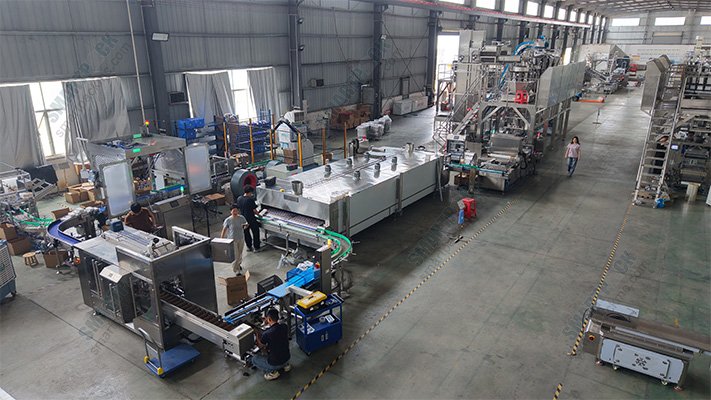
Smartpack designed the system as an integrated ready meal packaging line, with the output of each process matched to the overall production target.
Project Overview
| Project item | Requirement |
|---|---|
| Customer location | United States |
| Products | Four multi-ingredient ready meal recipes |
| Main ingredients | Cooked noodles or rice, meat, vegetables and sauce |
| Package | Preformed ready meal trays |
| Target line speed | Up to 40 trays/min |
| Nominal hourly output | Up to 2,400 trays/hour |
| Primary process | Ingredient portioning, sequential filling and tray sealing |
| Intermediate process | Checkweighing and cooling |
| Secondary packaging | Retail boxing and robotic case packing |
| Final process | Case sealing and palletizing |
The central engineering question was not whether one tray sealing machine could run at 40 trays per minute. It was whether every upstream and downstream process could maintain that output without creating accumulation, waiting time or excessive manual intervention.
The Production Bottleneck Was Bigger Than Tray Filling
The customer’s four products contained different ingredient combinations and portion ratios. Some required different types of cooked noodles, while another recipe used bulky broccoli and cooked beef.
Each ingredient also behaved differently during production:
- Cooked noodles could tangle during feeding.
- Cooked rice could stick or accumulate.
- Vegetables varied in size and occupied more tray space.
- Cooked meat needed controlled portions to reduce giveaway.
- Sauce had to be dispensed without contaminating the tray flange.
Smartpack selected suitable portioning equipment for these ingredients, but weighing accuracy was only one part of the project.
If the filling section produced 40 trays per minute while the tray sealer, cooler or boxing section could handle only 30, finished trays would accumulate between processes. More employees would then be needed to transfer, organize or temporarily store the products.
The customer therefore required the entire line—not just the filling station—to be designed around the same production objective.
Designing One Synchronized Ready Meal Packaging Line
The complete system was divided into connected production sections.
| Production section | Main function |
|---|---|
| Ingredient supply and portioning | Prepares noodles or rice, meat and vegetables in the required portions |
| Sequential tray filling | Deposits the ingredients and sauce into each tray |
| Tray sealing | Closes the completed ready meal package |
| Final inspection | Checks the total packaged-tray weight |
| Cooling | Reduces product temperature before secondary packaging |
| Boxing | Places or loads the finished trays into retail boxes |
| Case packing | Groups and loads boxed products into shipping cases |
| Case sealing and palletizing | Prepares completed cases for storage and transportation |
At 40 trays per minute, a completed tray enters the next production stage every 1.5 seconds on average. This does not necessarily mean every machine performs one complete action every 1.5 seconds. Some stations can process multiple trays per cycle, while cooling systems handle products through continuous or accumulated flow.
However, the average capacity of every section must remain compatible with the target line output.
Smartpack evaluated the production line as one system, including product movement between machines. This approach follows the same principles explained in its packaging line design guide: equipment speed, transfer method, package format, factory space and downstream handling must be planned together.
Sequential Filling for Four Ready Meal Recipes
The ready meal trays pass through several filling stations in sequence.
A typical production flow is:
- Empty trays enter the filling conveyor.
- Cooked noodles or rice are portioned into the trays.
- The required cooked meat portion is added.
- Cooked vegetables are filled at the next station.
- Sauce is dispensed according to the selected recipe.
- Completed trays move into the sealing machine.
This arrangement allows the ingredients to be controlled separately while maintaining a continuous tray flow.
The filling sequence can also help control product presentation. Instead of combining every ingredient before filling, noodles, vegetables, meat and sauce can be deposited in the required order and position.
When changing recipes, the customer can adjust the target settings for the relevant ingredients. For example, switching from a noodle-based recipe to Beef and Broccoli changes both the ingredients and their portion requirements without requiring an entirely separate packaging line.
This flexibility was important because the customer needed to produce several SKUs while maintaining consistent output.
Connecting Tray Sealing, Inspection and Cooling
After filling, the trays enter the sealing machine. The sealing process must remain synchronized with the upstream filling conveyor so that completed trays do not wait too long between filling and closure.
Each sealed tray then passes through a checkweigher.
The checkweigher provides final package inspection by detecting trays outside the permitted weight range. It acts as a final verification step rather than replacing the individual ingredient portioning systems.
After inspection, approved trays enter the cooling section. Cooling capacity is particularly important because a cooling process that cannot accept the upstream output can quickly become the main line bottleneck.
The operating parameters depend on factors such as:
- Product temperature after cooking
- Meal composition
- Tray dimensions and filling depth
- Required cooling time
- Cooling equipment capacity
- Factory food safety procedures
- Downstream boxing requirements
The customer is responsible for validating the final time and temperature parameters according to its products, regulatory jurisdiction and food safety plan. U.S. facilities should evaluate the applicable requirements, including the FDA’s Current Good Manufacturing Practice and Preventive Controls requirements under 21 CFR Part 117.
Smartpack’s role was to integrate the cooling process into the packaging flow so that it could receive sealed trays and deliver them to the next stage at the required production rate.
Preventing Boxing and Case Packing from Limiting Output
Many factories automate primary packaging but continue to rely on manual labor for boxing, case forming, case loading and pallet stacking.
At 40 trays per minute, this approach can create a new bottleneck immediately after the cooling section. Employees must continuously collect trays, load retail boxes, form shipping cases and stack finished cases.
For this project, the cooled ready meals move into a boxing machine before entering the end-of-line automation system.
The downstream system includes:
- Automatic case erector
- Product conveying and grouping
- Delta robot case packing system
- Automatic case sealing machine
- Robotic palletizing machine
The case erector forms shipping cases automatically. Boxed meals are conveyed, arranged and presented to the Delta robot. The robot then loads them into each case according to the required packing pattern.
Completed cases move through the case sealer before being transferred to the robotic palletizing station.
This configuration reduces repeated lifting and manual product transfer. More importantly, it allows secondary packaging to support the output of the upstream tray line.
The exact layout of an end-of-line packaging system depends on the retail box dimensions, number of boxes per case, loading orientation, case size, pallet pattern and available factory space.
How Smartpack Approached the 40-Tray-per-Minute Target
The target speed was treated as a complete-line requirement rather than the rated capacity of one machine.
To plan the production flow, Smartpack considered:
- How quickly each ingredient could be prepared and filled
- How many trays each filling station handled per cycle
- How recipe changes affected the filling sequence
- Whether the tray sealer could continuously receive filled trays
- Whether inspection could keep pace without interrupting product flow
- How cooling capacity affected the overall output
- How finished trays entered the boxing section
- How products were grouped for robotic case loading
- How cases were transferred to sealing and palletizing
Actual production speed may vary according to the recipe, ingredient temperature, tray design, cooling requirements, product replenishment, cleaning time and changeover frequency.
For this reason, Smartpack does not define complete-line output by quoting the maximum speed of the fastest machine. The practical output is determined by the slowest process under real production conditions.
Why the Customer Chose Smartpack
The customer evaluated more than equipment price. It also considered the supplier’s ability to understand the complete process and manage a highly customized automation project.
Complete Line Automation Capability
Smartpack could integrate the process from cooked-food portioning to finished pallet handling.
During technical discussions, the engineering team reviewed the recipes, ingredient characteristics, tray format, target speed, cooling process and secondary packaging requirements. The team also considered where bottlenecks could develop between machines.
This detailed communication demonstrated that Smartpack understood the difference between supplying individual packaging machines and designing a coordinated production line.
Relevant Project Experience
Smartpack has completed multiple weighing, filling and packaging projects involving cooked foods, sticky ingredients, multi-component meals and downstream automation.
Existing applications, including its ready-to-eat central kitchen packaging project, gave the customer relevant references for evaluating Smartpack’s technical capability.
These cases helped reduce the risk of investing in a customized production line. The customer could work with one system integrator instead of coordinating weighing, tray handling, sealing and end-of-line equipment from several unrelated suppliers.
Operational Benefits of the Integrated Line
The completed system provides several practical advantages.
Fewer Manual Transfers
Trays move automatically between filling, sealing, inspection, cooling and secondary packaging. This reduces manual collection and movement between separate production areas.
More Stable Production Flow
The major sections are designed around the same target output, helping prevent downstream processes from restricting filling capacity.
Flexible Recipe Production
The customer can change ingredient settings and filling sequences for different ready meal SKUs without installing a completely separate line for each recipe.
Reduced End-of-Line Labor
Automatic boxing support, case erecting, robotic case packing, case sealing and palletizing reduce dependence on repetitive manual handling.
One Integration Partner
Smartpack coordinates the interfaces between the individual machines. This simplifies line planning and helps the customer avoid compatibility problems between equipment supplied by multiple companies.
Planning a Similar Ready Meal Automation Project
A complete ready meal packaging line cannot be selected only according to the tray dimensions or required speed.
Before developing a proposal, Smartpack normally needs information about:
- Ready meal recipes and ingredients
- Portion weight of each ingredient
- Product temperature during filling
- Ingredient samples, photos or production videos
- Tray dimensions and compartment layout
- Required trays per minute
- Tray sealing method
- Cooling process and required capacity
- Retail box dimensions
- Number and orientation of boxes per shipping case
- Case dimensions and sealing method
- Required pallet pattern
- Available factory layout
- Current manual processes and labor bottlenecks
For this U.S. project, Smartpack used these production requirements to develop a coordinated line with a target output of up to 40 trays per minute.
The result was not simply a faster tray filling machine. It was an integrated production flow connecting multi-ingredient filling, sealing, inspection, cooling, boxing, robotic case packing and palletizing.
Manufacturers planning a similar project can review Smartpack’s complete ready meal packaging machine solutions or submit their recipes, tray specifications, production target and factory layout for technical evaluation.