

A powder manufacturer may sell 100 g samples, 500 g retail packs, 1 kg family packs and 5 kg commercial bags. Using one packing machine for all four sizes sounds more economical than installing separate lines, but a 50-times difference in filling weight cannot be handled by changing one number on the touchscreen alone.
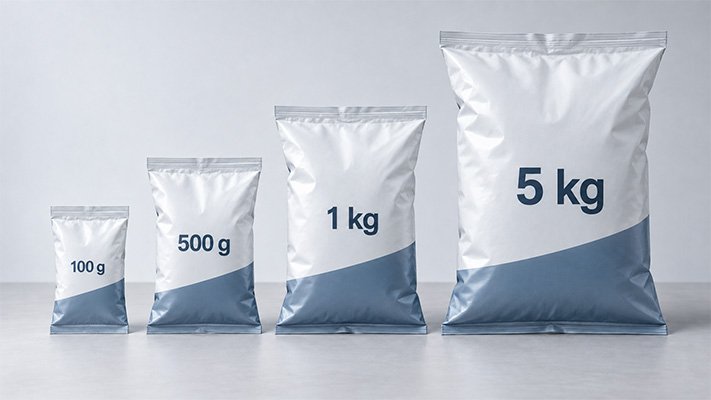
In many projects, one vertical powder packing machine can cover 100 g to 5 kg. However, it may require different auger screws, filling tubes, bag formers and film widths. Whether this is practical depends on the powder density, actual bag dimensions, required output and how frequently production changes between sizes.
The better question is therefore not simply whether the machine can fill all four weights. It is whether it can do so at an acceptable speed, accuracy and changeover time.
Can the Same Powder Packing Machine Run All Four Sizes?
Technically, one VFFS machine may be able to produce all four pack sizes if its frame and sealing system support the largest bag. The dosing system and forming parts can then be changed or adjusted for smaller bags.
That does not mean one fixed configuration will work equally well across the entire range.
A small auger selected for 100 g can also discharge 5 kg, but the filling cycle may be too slow. A large auger designed for 5 kg can fill quickly, but may not provide fine enough control for a 100 g dose. The same issue applies to the bag former. A former for a narrow 100 g bag is unlikely to produce the much wider bag needed for 5 kg.
A more realistic assessment looks like this:
| Target weight | Can the same VFFS machine be used? | Likely adjustments | Main point to check |
|---|---|---|---|
| 100 g | Usually yes | Smaller auger and bag former | Low-dose accuracy |
| 500 g | Usually yes | Recipe, film and bag-length adjustment | Powder in the seal |
| 1 kg | Usually yes | Larger former may be required | Filling speed |
| 5 kg | Depends on the project | Larger auger, former and bag support | Bag volume and load handling |
The VFFS machine may remain the same, but the complete setup may not.
Start with Powder Density and Actual Bag Size
Target weight alone is not enough to select a powder packing machine.
Five kilograms of a dense powder may fit into a manageable bag. Five kilograms of a light protein powder, milk powder or nutritional blend can occupy much more space and require a wider, longer bag. This affects the filling tube, bag former, film width and maximum bag length the machine must support.
Powder characteristics also affect how the product enters the bag. Free-flowing products move differently from powders that are dusty, easy to bridge or slightly sticky.
Before confirming the machine range, Smartpack normally checks:
- Powder type and composition
- Bulk density
- Flowability
- Dust level
- Actual bag width and length
- Film structure and thickness
- Required headspace above the powder
Providing filled bag samples is especially useful. They show the true package volume and prevent the machine from being selected according to weight alone.
How Auger Size Affects the Filling Range
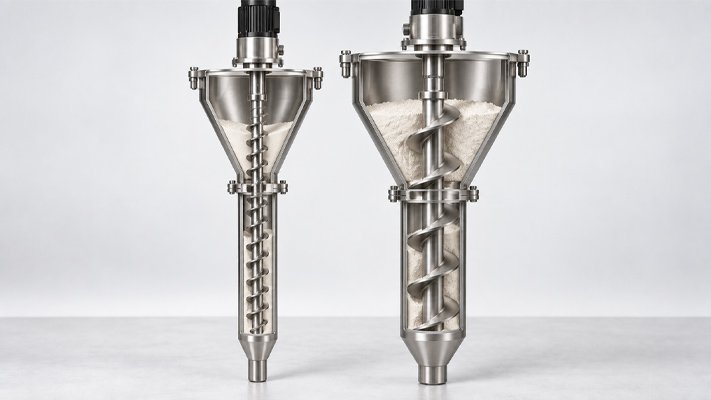
A smaller auger provides finer control for low target weights. It is normally more suitable for 100 g or 500 g packs, especially when accuracy is important. However, it needs more revolutions to fill a 5 kg bag, which extends the filling time and reduces output.
A larger auger moves more powder per revolution. It is more efficient for 1 kg and 5 kg bags, but each movement releases a relatively large quantity. This makes small corrections more difficult when filling only 100 g.
For a wide range such as 100 g to 5 kg, interchangeable auger sets are often more practical than one universal auger. A smaller set can be used for the lower range and a larger set for the heavier packs.
The machine recipes can store settings for each product and weight, but saved parameters cannot replace correctly sized mechanical parts.
Why One Bag Former May Not Fit Every Size
A VFFS machine forms a bag by wrapping packaging film around a forming collar. The size of this former determines the bag width.
If the 100 g and 5 kg bags have substantially different widths, they will need different formers. Trying to use one large former for every size can leave excessive empty space in the small bags and make them look poorly proportioned. A small former simply cannot produce the required width for a large bag.
Changing to another bag size may involve:
- Replacing the former
- Loading a different film roll
- Adjusting film tracking
- Changing the bag-length setting
- Checking the print-mark sensor
- Confirming the longitudinal and horizontal seals
The actual bag drawings should therefore be reviewed before the machine is manufactured. If the bag supplier has not finalized the sizes, Smartpack can test the powder volume and suggest a workable size range.
What Changes When Packing a 5 kg Bag?
The 5 kg format normally determines whether one-machine production is practical.
A filled 5 kg bag places considerably more force on the film and sealing area than a 100 g bag. If the bag hangs from the horizontal sealing jaws without support, its weight may pull on the film, affect bag length or reduce seal stability.
Depending on the bag and film, the machine may require:
- Bag-bottom support during filling
- A suitable heavy-bag discharge system
- A stronger film-pulling arrangement
- Longer sealing or cooling time
- A lower drop to the takeaway conveyor
- A conveyor designed for heavier finished bags
Dust control also becomes more important. Fast discharge into a large bag can create a cloud of powder. If the sealing jaws close before the product settles, powder may become trapped in the seal and cause leakage.
The fastest possible auger setting is not always the fastest reliable setting. A slightly longer filling or settling time may produce more saleable bags with cleaner seals.
How Packing Speed Changes from 100 g to 5 kg
One machine will not produce every bag size at the same speed.
A 100 g dose takes less time to discharge, while a 5 kg dose requires more auger revolutions, greater powder settlement and possibly additional bag support. Large bags may also need a longer sealing cycle.
For this reason, each target weight should have its own confirmed speed. A general statement such as up to a certain number of bags per minute is not useful unless it specifies the powder, weight and bag size used during the test.
The machine should be optimized around the factory’s main product.
If 500 g and 1 kg packs account for most daily production, the auger and machine setup should give these two sizes priority. Occasional 100 g and 5 kg orders can then run at acceptable speeds. Designing everything around the largest bag may unnecessarily reduce the performance of the sizes produced most often.
How to Check Filling Accuracy at Each Weight
Accuracy also needs to be tested separately for each target weight.
An error that is acceptable for a 5 kg commercial bag may be too large for a 100 g retail pack. Using one accuracy figure for the entire 100 g to 5 kg range can therefore be misleading.
Testing should record:
- Average filled weight
- Maximum positive and negative deviation
- Repeatability during continuous operation
- Accuracy at different hopper levels
- Results at the planned production speed
Powder density can change after refilling the hopper or during extended operation. Testing several consecutive batches gives a more reliable result than weighing only a few bags.
An inline checkweigher can provide a second weight check after sealing. It can reject packs outside the permitted range and provide production data for further adjustment of the auger filler.
Three Practical Ways to Configure the Packing Line
One Auger and One Former
This is the simplest option, but it is normally suitable only when the bags have similar widths and the dosing range is not too wide.
For 100 g to 5 kg, a fixed setup is likely to compromise either small-pack accuracy or large-pack speed.
One Machine with Changeable Augers and Formers
The main VFFS machine is shared, while different auger sets and formers are used for different weight ranges.
This configuration is suitable when:
- The four sizes are produced in separate batches
- 500 g and 1 kg are the main formats
- Production planning allows time for changeovers
- Floor space is limited
- 100 g or 5 kg production is less frequent
It provides a reasonable balance between flexibility, output and equipment investment.
Separate Small-Pack and Large-Pack Lines
Two lines are worth considering when 100 g and 5 kg are both major products or need to run simultaneously.
The small-pack line can be optimized for speed and fine dosing. The large-pack line can use a larger auger, wider former and heavy-bag handling system. This also avoids frequent mechanical changeovers.
The decision should consider lost production time during changeovers, not only the initial machine price.
What to Test Before the Machine Leaves the Factory
A factory acceptance test should cover the real operating range, not just the easiest bag size.
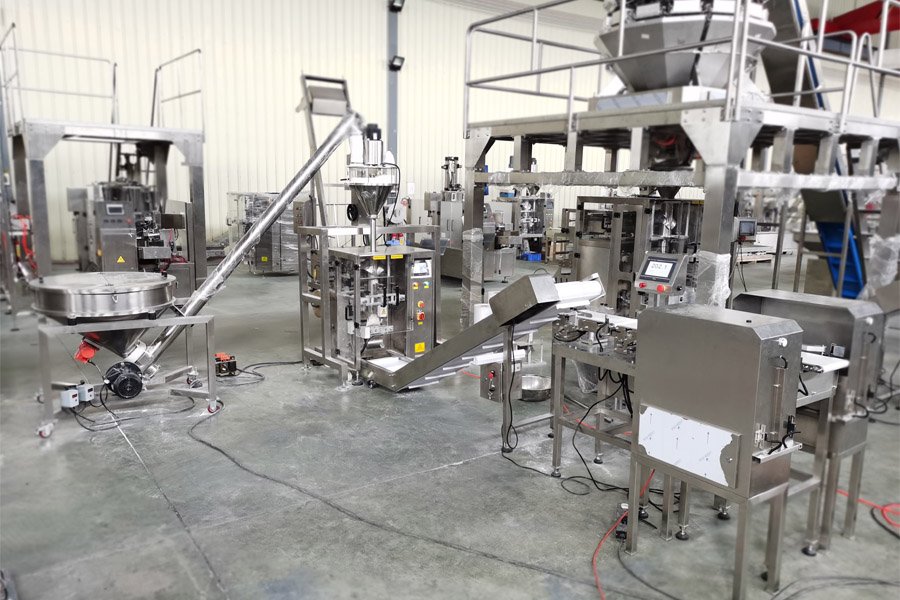
For this project, Smartpack recommends testing at least the 100 g pack, the most frequently produced size and the 5 kg bag. The test should use the customer’s actual powder and film whenever possible.
Important results include:
- Output for each tested weight
- Filling deviation over repeated cycles
- Powder accumulation around the filling tube
- Seal cleanliness and strength
- Stability of the 5 kg bag during filling
- Finished-bag discharge
- Time required to change the auger, former and film
- Performance after continuous operation
This test reveals whether the proposed setup merely fills all four weights or can handle them reliably in daily production.
When One Machine Makes Sense and When It Does Not
One powder packing machine can handle 100 g, 500 g, 1 kg and 5 kg bags in selected projects. In most cases, the practical solution is one VFFS machine with interchangeable augers and bag formers rather than one fixed configuration.
A shared machine makes sense when the sizes are produced in batches, the middle range accounts for most output and planned changeover time is acceptable.
Separate small-pack and large-pack lines become more practical when both ends of the range have high daily demand, frequent order changes or strict speed requirements.
Before recommending a configuration, Smartpack needs the powder sample or bulk density, actual dimensions of all four bags, required speed and production share of each size. With these details, the powder packing machine can be configured around the factory’s real production priorities rather than a theoretical weight range.