

You need a unique pack design that catches customer attention. You also need fast, accurate multipack bagging that eliminates manual labor. Finding one solution that delivers both is difficult.
We solved this by designing a complete two-stage line. First, a VFFS machine creates unique triangle-shaped liquid jelly sachets. Then, an automated counting multihead weigher system bags them into accurate multipacks, eliminating manual labor and product giveaway for our client.
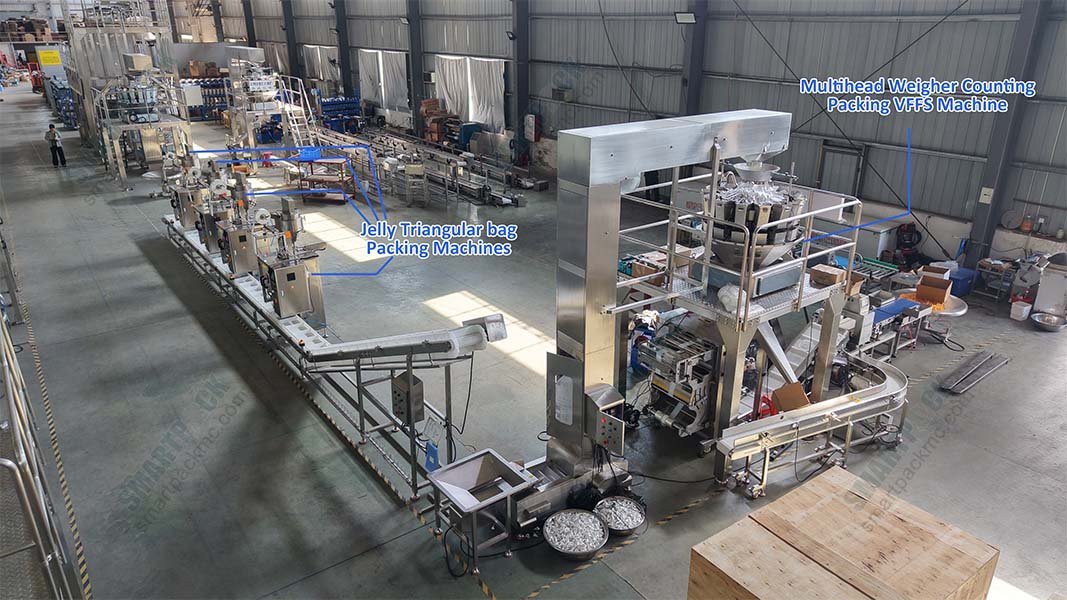
When one of the top jelly manufacturers came to me, they had a clear vision. They were launching a new liquid jelly product and needed to capture the market's attention. This meant they needed more than just a standard pouch. They also knew that to succeed in convenience stores and wholesale, they had to move away from slow, manual counting for their multipacks. They needed a single, seamless system that could create a unique primary pack and then automatically bundle it into secondary bags with precision. It was a challenge that required looking at the entire production flow, from the initial fill to the final case. Let me walk you through how we tackled this project from start to finish.
▶️ Watch the Liquid Jelly Triangle Bag Packaging Line in Action
What Was the Real Challenge Behind This Packaging Project?
Your packaging line affects everything. It shapes how customers see your brand. It determines your production costs. It limits or enables your market growth. Getting it wrong costs you money every single day.
The client faced three core problems. They needed distinctive shelf presence in a crowded jelly market. They struggled with inconsistent filling for viscous liquid products. They lost money through manual counting errors and product giveaway in their multipack operation.
I remember the first call with this client. Their existing operation was typical of many growing manufacturers in Southeast Asia. They had decent products but standard pillow pouches that looked exactly like their competitors. In convenience stores, shelf space is limited and competition is fierce. Without visual differentiation, they were just another jelly brand fighting on price alone.
But the primary packaging was only half their problem. Their secondary packaging operation was a bigger headache. Workers sat at tables manually counting sachets into wholesale bags. This was slow, which limited their output. It was also expensive, requiring significant labor costs. Most importantly, it was inaccurate. Sometimes workers miscounted and put in too many sachets, which meant giving away product and losing profit margin. Other times they put in too few, which led to customer complaints and damaged relationships with distributors.
The liquid jelly itself presented technical challenges. At room temperature, the viscosity could vary. This made consistent dosing difficult with standard volumetric filling systems. They needed a solution that could handle the material's flow characteristics while maintaining accuracy across thousands of sachets per hour. The combination of these challenges meant they couldn't just buy off-the-shelf equipment. They needed a partner who understood both the technical requirements and their business goals.
How Do You Create a Stand-Out Primary Pack for Liquid Jelly?
Your product is great, but it gets lost on a crowded shelf. Standard packaging just doesn't cut it anymore. We help you create unique shapes that make customers notice your brand.
We used our Liquid Jelly Triangle Bag VFFS Machine. It uses a custom mold system to form the distinctive triangle shape. A high-accuracy ceramic pump ensures consistent small doses, while a heated hopper keeps the jelly flowing smoothly for reliable filling and sealing.

The first goal was brand impact. A standard pillow pouch wasn't going to create the shelf presence our client needed. The solution was a machine specifically engineered for non-standard shapes. The key was its custom mold system. This allowed us to create the triangle shape they wanted, but it also gave them flexibility for the future. With a simple mold changeover, they could introduce other custom shapes for new product lines or seasonal promotions.
But a unique shape is useless without consistent filling. For a viscous product like liquid jelly in small volumes, this is tricky. We solved this with two key features. First, a high-accuracy ceramic pump delivered precise dosing in their target range of 2–25 ml. Ceramic pumps are superior for this application because they handle viscous materials better than piston systems and maintain accuracy even with temperature variations. Second, a heated hopper maintained the jelly's temperature between room temperature and 80°C. This ensured the jelly's viscosity stayed constant throughout production shifts, preventing flow issues that could cause underfilling or air pockets in the sachets.
The machine runs at 30–45 bags per minute, which matched their initial production volume perfectly. The metering accuracy specification is better than ±0.8%, though the actual accuracy depends on the specific jelly formulation and temperature control. All contact parts are constructed from 304 stainless steel, meeting both food safety standards and the humid factory environment. The PLC control system with touch screen interface makes it easy for operators to adjust parameters, change mold settings, and monitor production in real-time.
Key Machine Features
| Feature | Specification | Benefit for the Client |
|---|---|---|
| Pouch Shaping | Custom Mold System | Created unique triangle shape; allows for future designs. |
| Filling System | High-Accuracy Ceramic Pump | Ensures consistent dosing for small 2–25 ml volumes. |
| Hopper | Heated (Room Temp to 80°C) | Maintains jelly viscosity for smooth, stable flow. |
| Production Speed | 30–45 bags/min | Meets initial production volume targets. |
| Metering Accuracy | Better than ±0.8% | Reduces product waste and ensures consistent fill. |
| Construction | Full 304 Stainless Steel | Ensures durability and meets food safety standards. |
How Do You Automate Multipack Counting for Small, Flexible Sachets?
Manually counting items for multipacks is a huge bottleneck. It's slow, prone to errors, and leads to costly product giveaway or unhappy customers who get short-changed. We automate this process.
Our solution is an automated counting multihead weigher integrated with a VFFS machine. It uses a "counting by weight" principle with a self-learning algorithm. The weigher quickly and accurately calculates the correct number of sachets, ensuring each multipack is perfect without manual intervention.

Once the primary triangle sachets were produced, the next challenge was to replace hand-counting. Manual labor was not only slow but also a major source of inaccuracy. Giving away just one extra sachet in every bag adds up to significant losses over time. To solve this, we installed our Automated Jelly Cup / Triangle Jelly Bags Counting Multihead Weigher VFFS for Secondary Packaging. This system is designed specifically for secondary packaging. It takes the individual sachets, automatically counts them, and then packs them into larger pillow or gusset bags for wholesale.
The core technology here is "counting by weight." The multihead weigher's control system knows the average weight of a single sachet. It then rapidly combines weights from different hoppers to hit a target weight that corresponds to the desired piece count. With a dual verification logic, the system double-checks itself, delivering high accuracy even at speeds up to 70 bags per minute. This protects profits by eliminating overfill and ensures customer satisfaction by preventing under-counts.
The system uses a 14- or 16-head counting weigher configuration. More heads mean more combination options, which translates to better accuracy and faster speeds. The self-learning algorithm is crucial. As the line runs, it continuously tracks the weight of individual sachets and adjusts its calculations. This compensates for minor variations in sachet weight that occur naturally during production. The result is consistent piece counts even when individual sachet weights vary slightly due to fill variations or film thickness differences.
Secondary Line Capabilities
| Feature | Specification | Benefit for the Client |
|---|---|---|
| Weigher Configuration | 14/16 Head Counting Weigher | More combinations for better accuracy and speed. |
| Counting Principle | Counting by Weight (with dual verification) | Fast, accurate, and eliminates manual counting errors. |
| Target Count | 5–20 pieces per bag | Flexible for different retail and wholesale pack sizes. |
| Bag Styles | Pillow Bag / Gusset Bag | Adaptable to various packaging needs for different channels. |
| Speed | 25–70 bags/min | Scalable to meet growing market demand. |
| Bag Size Range | Length 100–450 mm, Width 80–350 mm | Accommodates various multipack formats. |
| Construction | Full 304 Stainless Steel | Provides a robust and hygienic secondary packaging line. |
What Results Did This Integrated Line Deliver?
You invest in new equipment to improve your business. But success isn't just about installing machines. It's about solving real problems, protecting profits, and enabling growth.
This line delivered measurable results across four key areas. Brand differentiation created immediate market impact. Process stability improved quality consistency. Automated counting eliminated giveaway and labor costs. The scalable design supports future growth without major reinvestment.

The triangle sachets created instant shelf impact. In retail tests, the unique shape increased consumer attention and trial rates compared to their previous standard pouches. This validated the client's strategy of using packaging as a brand differentiator. The custom mold system also gave them confidence to plan future product extensions with different seasonal shapes or premium designs for special editions.
Process stability improvements were equally important. The ceramic pump dosing combined with hopper heating delivered consistent filling performance throughout production runs. This reduced quality complaints and minimized product waste from rejected sachets. The heated hopper eliminated the flow problems they previously experienced when starting cold or during ambient temperature changes in the factory.
The automated counting system transformed their secondary packaging economics. Labor costs dropped significantly as workers were redeployed to other value-adding tasks. Product giveaway was virtually eliminated, protecting profit margins on every wholesale bag. The accuracy of the counting-by-weight system with verification meant they could confidently guarantee piece counts to distributors, strengthening their business relationships.
Perhaps most importantly, the line was designed for scalability. The secondary line's speed range of 25–70 bags per minute means they can increase output as market demand grows without replacing the equipment. The flexibility to produce both pillow and gusset bags allows them to serve different sales channels efficiently. As their business expands, they can easily add downstream modules like checkweighers, metal detectors, or automated case packing to further optimize their operation.
Conclusion
This integrated two-stage system gave our client brand differentiation and scalable efficiency, securing their market position. We delivered a complete solution from primary sachet to final multipack that addresses both today's needs and tomorrow's growth.