

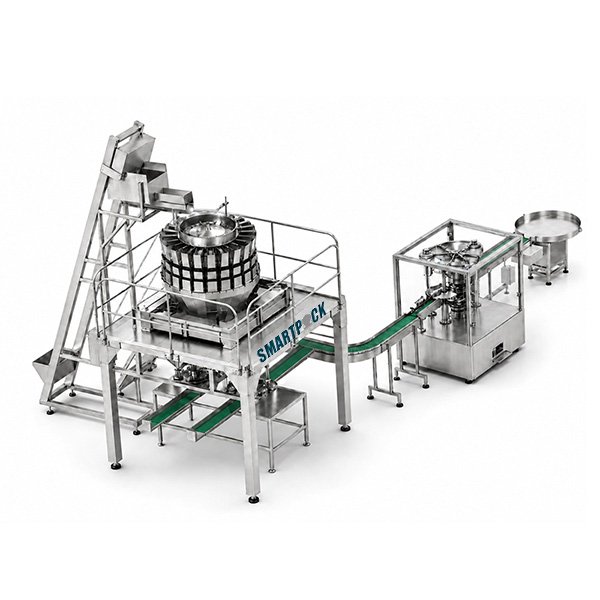
Wet pet food filling must accurately portion sticky meat or fish, maintain the required solid-to-gravy ratio and protect pouch seals or can rims. Because wet food ranges from chunks in gravy to loaf and mousse, the correct filling principle changes by product condition and package, as shown in the FEDIAF overview of wet pet food production.
Smartpack approaches the process as three coordinated operations:
- Weigh and discharge the sticky solid ingredients.
- Dose gravy or sauce separately when ratio control is required.
- Guide both components into the package without unnecessarily contaminating the sealing area.
Match the Filling Method to the Product
Machine selection should begin with the condition of the food, not only the package type. Two products packed in the same retort pouch may require completely different dosing systems.
| Wet pet food condition | Main filling challenge | Recommended filling method |
|---|---|---|
| Separable meat or fish chunks | Sticky, irregular pieces | Screw-feeding multihead weigher |
| Shredded meat or tuna flakes | Bridging and uneven hopper feeding | Customized screw multihead weigher |
| Chunks in gravy | Variation in solid-to-liquid ratio | Solid weighing followed by separate gravy dosing |
| Pâté, mousse or meat paste | Cannot be combination-weighed effectively | Piston, servo or pump filler |
| Gravy or broth | Dripping and unstable cutoff | Liquid filler with an anti-drip nozzle |
Use a screw multihead weigher only when pieces can be separated and combined into a target weight. Pâté, mousse, paste and mainly liquid recipes generally require a piston, servo or pump filler. Smartpack evaluates stickiness, piece size, temperature, free-liquid content, target portion and output before recommending a system.
Weigh Sticky Meat with a Screw Multihead Weigher
Conventional multihead weighers use vibration to move products into the weigh hoppers. That works well for free-flowing kibble, but wet meat behaves differently. Soft chunks may absorb the vibration, tuna flakes can bridge above the hopper and oily products may remain on the feeding pan or discharge chute.
Uneven feeding reduces the number of useful weight combinations and can cause unstable speed, excessive giveaway, underweight portions and frequent operator intervention.
A screw-feeding multihead weigher actively moves the product toward each weigh hopper. Screw speed can be adjusted according to the product condition and target weight. Stable performance, however, also depends on:
- Product distribution above the screws
- Screw diameter and feeding speed
- Hopper shape and opening angle
- Contact-surface treatment
- Discharge chute angle
- Drop height into the package
- Access for removal and cleaning
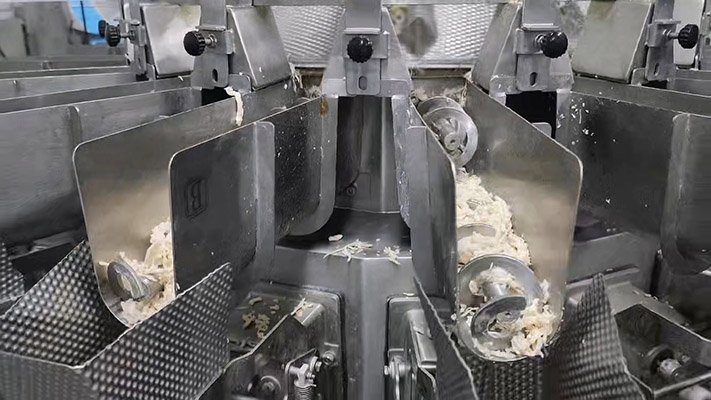
Product temperature must be included in the test. Chilled meat, warm cooked meat and meat held in the feeding system for a longer period can flow differently. For suitable sticky chunks or fish flakes, Smartpack can configure the system around an accuracy target such as ±3 g, but the result must be verified using the customer’s actual product, portion weight and production speed.
Product-contact parts also need to be designed for practical cleaning. The EHEDG hygienic design principles emphasize that poor equipment design makes effective cleaning more difficult. For a wet product line, accessibility, drainage and residue-prone areas should therefore be reviewed together with weighing performance.
Control Meat and Gravy as Separate Portions
Chunks in gravy look like one product in the finished package, but the two components require different dosing methods. Solid pieces are better controlled by weight, while gravy is normally handled by a pump or liquid dosing system.
If both components are filled from one mixed hopper, the total weight may be correct while the internal ratio changes from pack to pack. A checkweigher cannot identify this difference because it measures only the completed package weight.
Smartpack typically uses a two-stage process:
- The screw multihead weigher portions the meat chunks, shredded meat or fish flakes.
- The solid portion is discharged into the pouch, tray or can.
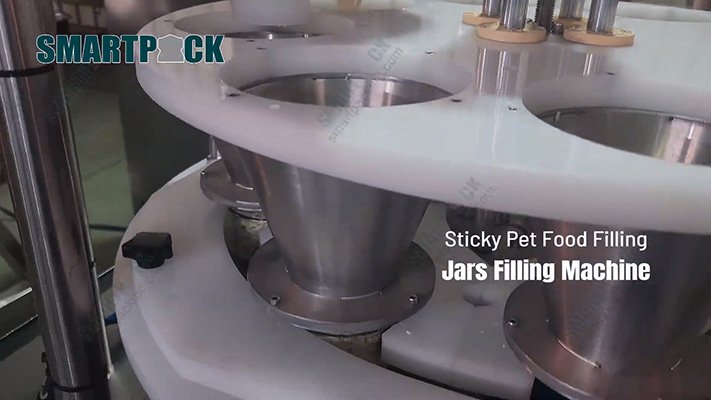
Tuna flakes weighing and gravy dosing process - An independent filler adds the required quantity of gravy.
- The completed pack is checkweighed before or after sealing.
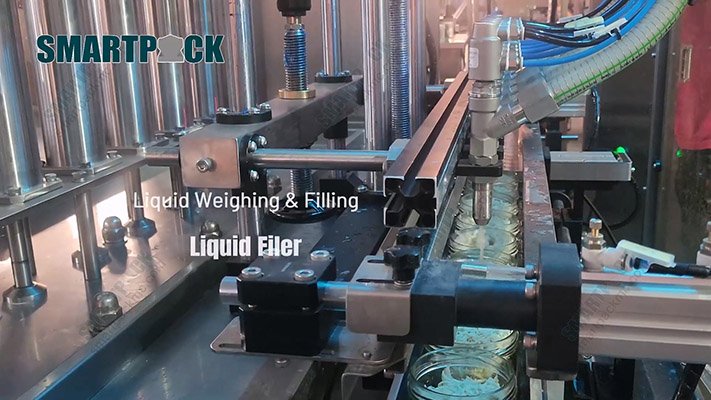
This configuration allows the factory to control two separate targets:
- Solid ingredient weight
- Final net weight after gravy dosing
It is particularly useful when different SKUs require different meat-to-gravy ratios. The meat target and gravy dose can be changed independently instead of adjusting one mixed filling process.
Single-stage filling may still be suitable for homogeneous formulas, very small solid particles or products without a strict ratio requirement. The correct choice depends on what the factory needs to control in the finished pack.
Reduce Pouch and Can Seal Contamination
Wet pet food can reach the sealing area when meat scatters during discharge or gravy continues to drip after dosing. The objective is to control the filling path and product cutoff so that contamination risk is reduced before sealing.
For retort pouches, the system should:
- Open and hold each pouch securely
- Match the filling chute to the pouch opening
- Minimize unnecessary product drop height
- Guide solids below the sealing area
- Position the gravy nozzle deeper inside the pouch
- Stop liquid flow cleanly after dosing
- Keep the pouch stable during air removal and sealing
Filling meat first and gravy second provides more control than discharging an uncontrolled mixture. A wider chute can guide the solids, while a separate nozzle delivers gravy lower inside the pouch.
Seal condition should be checked during continuous testing, not just in the first few cycles. Although the applicable regulatory requirements depend on the product and market, the FDA inspection guidance for retort pouches illustrates the importance of recurring visual examination of pouch seals rather than relying on a one-time check.
For cans, each container must be aligned with its discharge outlet. Misalignment can leave meat on the rim, while excessive gravy dosing can cause overflow before lid placement. The solid filler, gravy doser, can conveyor and seamer must therefore operate as one synchronized system.
For factories using premade pouches, Smartpack's wet pet food vacuum retort pouch packing line combines screw multihead weighing with pouch loading, opening, filling and vacuum sealing. It handles 50–1000 g portions with an accuracy of ±3 g and a maximum rated speed of 80 pouches/min. Optional gravy dosing, coding and checkweighing can be integrated according to the recipe and quality-control requirements. Actual speed should be confirmed with the customer's product and pouch.
Design the Line Around Stable Output
The highest speed shown for a pouch machine or can seamer does not represent the stable output of the complete line. Capacity may be limited by feeding, weighing, package positioning, gravy dosing, sealing or downstream case packing.
For rigid containers, Smartpack's canned wet dog and cat food filling and sealing line combines a screw multihead weigher with can filling and seaming equipment. It covers 100–2000 g portions at ±3 g. The standard configuration runs at 20–50 tins/min, while a customized high-speed line can reach up to 150 tins/min depending on the product, fill weight, container and sealing process. Empty-can feeding, separate gravy dosing, lid placement, coding and checkweighing are optional.
For canned wet pet food, Smartpack can configure one weighing cycle to fill four cans simultaneously. For higher-capacity projects, the discharge arrangement can be customized for six cans per cycle.
Multi-can filling helps match an intermittent weighing cycle with the continuous demand of a can conveyor and high-speed seamer. It requires accurate can positioning, controlled distribution across all outlets and synchronized conveyor movement.
A complete canned line can include:
Empty can feeding → screw multihead weighing → four- or six-can filling → gravy dosing → lid placement → can seaming → checkweighing → case packing → palletizing
A retort pouch line can include:
Product feeding → screw multihead weighing → pouch opening → meat filling → gravy dosing → air removal or vacuum → sealing → coding → checkweighing
Smartpack can integrate feeding and weighing with primary packaging, inspection, robotic case packing and palletizing.
Test the Real Product Before Buying
A useful wet pet food test should reproduce the difficult parts of production, using the customer’s actual product at a realistic filling temperature.
Before testing, Smartpack collects:
- Product condition and temperature
- Minimum and maximum piece size
- Stickiness and free-liquid content
- Target solid weight and gravy amount
- Final net weight
- Pouch, tray or can dimensions
- Required stable output
- SKU and changeover requirements
- Existing upstream and downstream equipment
The test should record more than the fastest cycle. Important results include consecutive weight variation, ratio consistency, stable output, product residue, recovery after a short stop, package-positioning accuracy, seal-area or can-rim contamination, dripping after gravy dosing and cleaning time.
If a supplier only demonstrates several acceptable samples, the result does not show whether the system can remain stable over a full production run.
Choose the Filling Principle Before the Machine Model
Choose a screw-feeding multihead weigher when separable but sticky meat chunks, shredded meat or fish flakes require accurate weight combinations. Use independent solid and gravy dosing when the meat content must remain consistent between packages. Use a piston, servo or pump filler for homogeneous pâté, mousse, paste or liquid recipes.
Only after selecting the filling principle should the pouch machine, canning line or tray system be determined according to the package, sealing process, required output and downstream automation.
Smartpack develops complete pet food packing machine solutions covering feeding, weighing, filling, primary packaging, inspection, case packing and palletizing. The system is configured around the customer’s actual food and production target instead of matching every wet pet food product to one standard machine.
For project evaluation, send Smartpack:
- Product photos and a running video
- Product temperature and piece-size range
- Target meat-to-gravy ratio
- Package weight and dimensions
- Required packs or cans per minute
- Factory layout
- Information about existing equipment
Whenever possible, provide real product samples for testing. The goal is not only to fill wet pet food, but to maintain the solid portion, control the gravy dose, protect the sealing area and keep the complete line running steadily.