

Choosing a pet food packing machine involves more than deciding whether a product is dry or wet. Free-flowing kibble, fragile freeze-dried cubes and sticky meat chunks behave differently during feeding, weighing and filling. Selecting a machine only by package style or maximum speed can cause breakage, inaccurate portions or contaminated seals.
The correct system depends on flowability, moisture, particle size, density, fragility, target weight, package dimensions and required output. Difficult products should be tested to confirm feeding, accuracy and realistic speed.
Pet Food Packing Machine Selection at a Glance
| Pet Food Type | Product Condition | Recommended Measuring System | Recommended Packing Machine |
|---|---|---|---|
| Dry dog and cat kibble | Free-flowing granules | Standard multihead weigher | VFFS machine |
| Premium kibble and dry treats | Free-flowing, higher-value product | Standard multihead weigher | Premade pouch machine |
| Freeze-dried meat cubes | Lightweight and fragile | Gentle-feed multihead weigher | Premade zipper pouch machine |
| Sticky wet meat or fish | Moist, sticky and irregular | Screw multihead weigher | Vacuum or retort pouch machine |
| Wet chunks with gravy | Solids mixed with liquid | Screw multihead weigher plus sauce filler | Vacuum or retort pouch machine |
| Canned wet pet food | Sticky chunks, tuna or fish flakes | Screw multihead weigher with multi-can distributor | Can filling and seaming line |
The package alone does not determine the correct weigher. Dry kibble and wet meat chunks can both be packed in premade pouches, but their feeding and weighing systems are completely different.
Four Main Types of Pet Food Packing Machines
VFFS Packing Machine for Dry Kibble
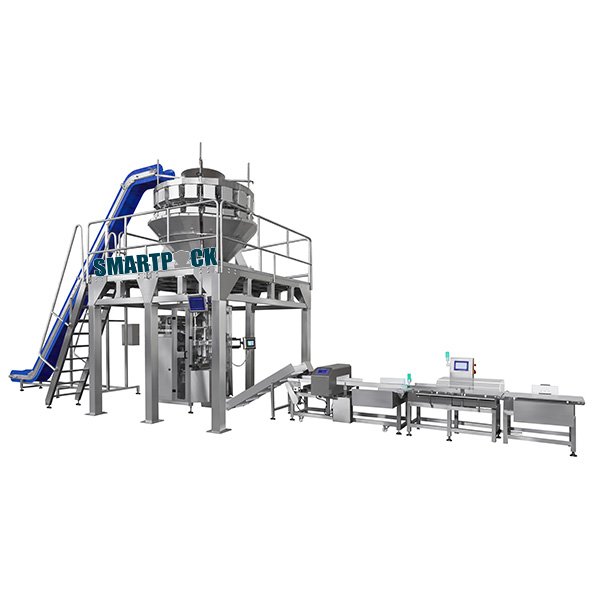
A vertical form fill seal machine is commonly used for dog food, cat food, extruded kibble, dry pellets and free-flowing treats. A multihead weigher portions the product while the VFFS machine forms, fills and seals bags from roll film. It can produce pillow, gusset and quad seal formats.
The SmartPack dry pet food kibble VFFS line supports pack sizes from 100 g to 5 kg and approximately 30–80 packs per minute. Typical deviation is around ±1.5 g for smaller packs and ±3–5 g for larger packs, subject to the kibble, target weight, bag length and configuration.
VFFS is economical for high-volume products and stable bag formats. It is not the best choice for sticky wet food, specialty premade zipper pouches or extremely fragile freeze-dried cubes unless gentle handling is added.
Premade Pouch Machine for Premium and Freeze-Dried Pet Food
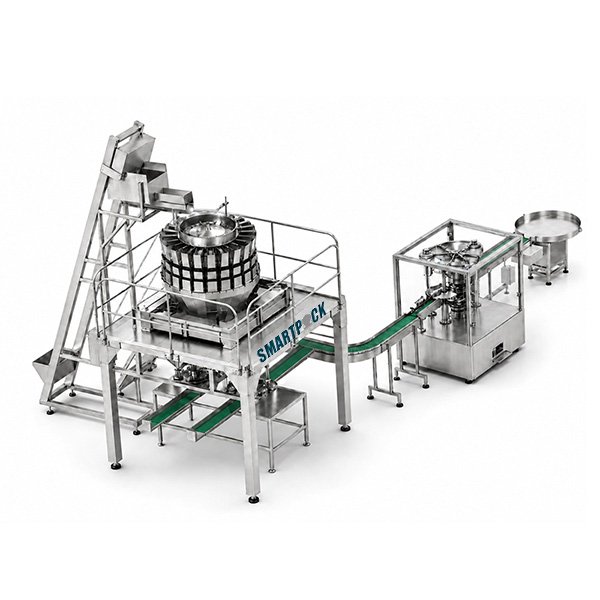
Premade zipper pouches suit premium kibble, freeze-dried meat, small treats and trial packs because they offer strong shelf presentation and resealability. Their higher cost should be justified by the product’s commercial value.
Freeze-dried pieces need special attention. They are lightweight, bulky and easily broken. A controlled infeed, shorter drop distance and cushioned discharge can reduce impact and powder formation. Hopper volume and pouch-opening width may limit speed even when the target weight is low.
The SmartPack freeze-dried pet food doypack line combines controlled weighing with premade pouch opening, filling and sealing. This format is less suitable for price-sensitive commodity kibble, extremely high output with one fixed bag style, or sticky wet products without a different weighing system.

Vacuum and Retort Pouch Machine for Wet Pet Food
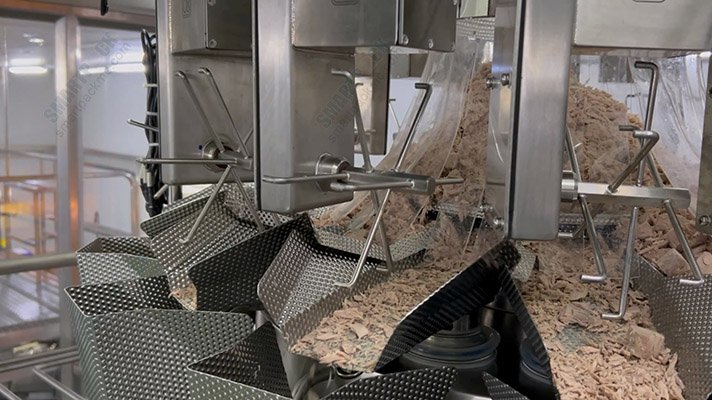
Wet meat chunks, tuna flakes and fish pieces do not flow reliably through a standard vibration-fed weigher. A screw multihead weigher actively moves sticky product into the weigh hoppers. Solids and gravy can be dosed separately for better ratio control and a cleaner seal area.
Vacuum packaging removes air from the pouch. A retort pouch is a heat-resistant package designed for subsequent sterilization; the two terms are not interchangeable.
The SmartPack wet pet food vacuum retort pouch line handles target weights from 50 to 1,000 g, with output up to 80 pouches per minute and a typical deviation of ±3 g, depending on product condition and line configuration.
This system is unnecessarily complex for dry kibble. A homogeneous liquid or paste may be better handled by a pump or piston filler. Retort projects must also verify pouch material, sealing, hygiene and downstream sterilization.
Filling and Seaming Line for Canned Wet Pet Food
A canned pet food line can integrate empty-can feeding, screw multihead weighing, multi-can filling, sauce dosing, lid placement, can seaming, checkweighing, rejection and conveying to retort processing.
The SmartPack canned wet pet food filling and sealing line fills four cans per cycle as a standard configuration, with six-can distribution available for customized higher-output projects.
Although the can seamer may have a much higher rated speed, real line output depends on whether weighing, distribution, sauce dosing, seaming and conveying capacities are correctly balanced. Evaluating the seamer speed alone can create an upstream filling bottleneck.
This solution may not be economical for very small batches with frequent can-size changes. It also requires sufficient floor space and suitable downstream sterilization and can-handling equipment.
How to Choose the Right System for Your Factory
Start with the product rather than the machine. Free-flowing kibble normally suits a standard multihead weigher. Fragile freeze-dried pieces require gentle feeding and controlled drop. Sticky chunks need screw feeding, while mainly liquid products may require a pump or piston filler. If solids and gravy must maintain a defined ratio, use separate solid and liquid dosing.
Next, compare realistic production conditions. Target weight, density, bag length, pouch-opening time, vacuum cycle and discharge time affect output. For cans, also consider the number filled per cycle and downstream equipment capacity.
Ask the supplier for a tested speed using your product and target weight—not only the mechanical maximum of the packing machine.
Check product-contact materials, removable hoppers and screws, washdown limitations, changeover time and areas where wet food may collect. Growing factories should reserve interfaces and space for inspection, case packing and palletizing.
Package format also affects the investment decision. Roll-film bags generally offer a lower packaging cost for high-volume kibble. Premade zipper pouches provide a more premium appearance and easier resealing. Vacuum and retort pouches require more attention to seal cleanliness, while cans need additional filling, seaming, sterilization and conveying equipment.
What a Real Pet Food Packaging Test Should Verify
SmartPack uses sample testing for sticky, fragile or irregular products. In a confirmed multi-can configuration, sticky wet food was weighed and distributed into four cans per cycle. Final accuracy and output should only be stated with the product size, target weight, test duration and recorded results.
A complete test should follow a clear process:
- Record product dimensions, density, moisture, stickiness and fragility.
- Confirm target weights and actual pouch or can dimensions.
- Select a preliminary feeding and weighing structure.
- Run repeated weighing and filling cycles.
- Inspect breakage, hopper residue, filling consistency and seal cleanliness.
- Record deviations and actual output under agreed test conditions.
- Adjust screw speed, hopper design, drop timing or filling distribution when needed.
- Provide the customer with a test video, result summary and recommended configuration.
For freeze-dried products, the test should record visible breakage and powder generation after repeated cycles. For wet food, engineers should inspect hopper residue, discharge consistency and seal-area contamination. For canned products, the test should confirm whether all cans receive a consistent portion when filling simultaneously.
This turns a general recommendation into a configuration supported by observable results.
From One Machine to a Complete Pet Food Packaging Line
SmartPack can connect product feeding, weighing, bag or can filling, sealing, coding, metal detection, checkweighing, automatic rejection, case packing, case sealing and robotic palletizing.
Not every factory needs full end-of-line automation immediately. A startup or multi-SKU producer may begin with feeding, weighing, primary packing and inspection while reserving interfaces for future expansion. The initial layout should support current output without creating a bottleneck when case packing or palletizing is added later.
Factories planning higher output should evaluate the complete flow rather than purchasing separate machines independently. The capacities of the weigher, packing machine, inspection equipment and end-of-line system must be matched to maintain stable production.
Information to Prepare Before Requesting a Quotation
Provide the supplier with:
- Pet food name, photos and representative samples
- Particle dimensions, bulk density, moisture and stickiness
- Fragility and acceptable breakage level
- Minimum and maximum target weights
- Bag, pouch or can dimensions
- Packaging material and sealing requirements
- Required output at each target weight
- Existing equipment and available factory layout
- Coding, metal detection and checkweighing requirements
- Future case packing or palletizing plans
More complete product and package information allows the engineering team to calculate a realistic configuration instead of quoting a general-purpose machine that may not perform as expected.
Conclusion
The right pet food packing machine is determined by how the product behaves, how it must be measured and how the final package is handled—not by bag style or advertised speed alone. Matching the weigher first, verifying difficult products through testing and planning the full line around realistic output will reduce product loss, sealing problems and future bottlenecks.
Send SmartPack your product samples, target weights, package dimensions and required output. Our engineering team can recommend a suitable weighing and packing system and prepare a customized line layout based on verified production requirements.