

A 500 g bag can weigh exactly 500 g and still contain too little freeze-dried chicken, beef or fish. That is the main difficulty when you pack kibble with freeze-dried toppers: total pack weight and recipe ratio are two different controls.
Because kibble and freeze-dried pieces differ in size, density and shape, a uniform blend may separate again in a hopper, elevator or feeder. To keep the recipe stable, your line must control the ingredients as well as the finished bag weight. Here is how to decide between premixing and separate weighing—and how to test the result.
Why the Mix Ratio Changes Before Packing
Imagine a 500 g recipe containing 5% freeze-dried topper:
| Component | Target per Bag |
|---|---|
| Kibble | 475 g |
| Freeze-dried topper | 25 g |
| Total | 500 g |
If the bag contains 485 g of kibble and only 15 g of topper, a checkweigher will still see a correct 500 g pack. Your customer, however, receives 40% less topper than the recipe target.
Freeze-dried pieces are usually lighter and bulkier than kibble. Small kibble can move between the larger pieces, while light toppers may remain near the surface or follow a different path at a conveyor discharge. Bulk-material specialists identify particle size, shape and density as common causes of segregation; bins, drops and conveyors can intensify it. This overview of material segregation mechanisms explains the main patterns.
On a pet food line, ratio drift commonly develops at:
- Mixer discharge and large buffer hoppers
- Elevators, inclined conveyors and long drops
- The distribution cone above a multihead weigher
- Production restarts after product has been standing
- The end of a batch, when one ingredient runs out first
Mixing the ingredients correctly is therefore only the first step. You also need to preserve—or re-establish—the ratio at the point of weighing.
When Is Premixing Good Enough?
Premixing followed by one standard multihead weigher is the simplest arrangement: one feeding route and one combined weight target.
This approach may work when:
- The ingredients have reasonably similar dimensions and flow behavior.
- The topper percentage is not extremely low and your tolerance is fairly broad.
- The transfer from mixing to packing is short, without long storage in a deep hopper.
- Repeated tests show a stable blend from the beginning to the end of a batch.
One ordinary weigher controls only combined weight; it cannot confirm that 500 g contains 475 g of kibble and 25 g of topper. Premixing becomes risky when the inclusion rate is low, the tolerance is tight or small, dense kibble is paired with large, light cubes. Test consecutive bags from the beginning, middle and end of a run. If the topper moves outside tolerance, use direct component control.
Separate Weighing Gives You Direct Ratio Control
With separate weighing, the line assigns an individual target to each material. For the example above, the control system prepares 475 g of kibble and 25 g of freeze-dried topper, then releases both portions into the same pouch.
There are two common ways to build this process.
Divided Weighing Zones
A multi-zone or mixture multihead weigher can reserve one group of feeding and weighing heads for kibble and another group for the topper. Each section receives only its assigned material and calculates combinations against its own target.
This keeps the line compact, but a 5% topper does not mean that exactly 5% of the heads should receive it. Head allocation depends on:
- Component targets and acceptable deviation
- Average piece weight and bulk density
- Occupied hopper volume
- Required bags per minute
Large freeze-dried cubes can fill a hopper while contributing very little weight. They may therefore need more hopper volume or more feeding capacity than their percentage suggests.
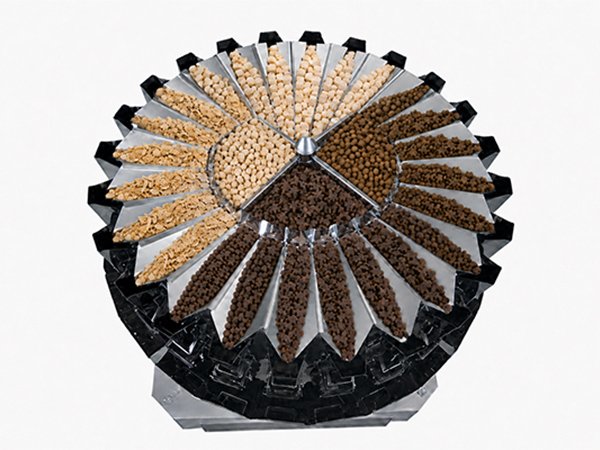
Independent Weighing Systems
Two independent weighers offer more flexibility when the ingredients behave very differently, the topper dose is very small or output is high. Each has its own supply and target; the PLC synchronizes discharge into one bag. This option also supports more inclusions, but needs extra platform space and a carefully designed discharge path.
| Production Requirement | Practical Starting Point |
|---|---|
| Similar ingredients and broad ratio tolerance | Premix and use one weigher |
| Visible topper with tighter bag-to-bag control | Divided-zone multihead weigher |
| Very low topper percentage | Separate precision weighing |
| Large density or size difference | Separate feeding and weighing |
| Several independently controlled ingredients | Multi-zone or multiple weighers |
| High output with strict recipe control | Independent synchronized weighers |
Keep the Ingredients Separate Until They Are Weighed
Separate weighing will not help if kibble and toppers share the same elevator or buffer hopper before entering their assigned zones. A reliable system normally gives each ingredient its own feeding path.
The design may include:
- Separate inlets and elevators or conveyors
- Level sensors and low-level alarms for each ingredient
- A physical divider above the weighing zones
- Controls that prevent cross-feeding
If the topper feeder alternates between overfilled and nearly empty, its feed rate changes and the bagger may have to wait. If either component is not ready, the system should stop that cycle—not add more kibble to hide the missing topper.
You also need to protect the freeze-dried pieces along this separate route. Lower drops, controlled vibration, suitable hopper gates and a wide discharge path can reduce broken corners and fines. For a closer look at this part of the line, see how to reduce breakage when packaging freeze-dried pet food.
Match the Weighing System to the Bagging Machine
Once both component portions are ready, they must enter the bag without blocking the product path or contaminating the seal.
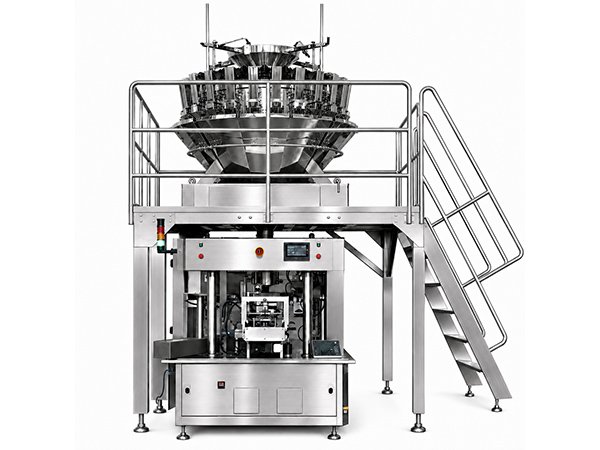
For regular pillow, gusset or quad-seal bags, a kibble VFFS packing line can provide efficient roll-film packaging. Confirm that the forming tube is wide enough for the largest freeze-dried pieces and that the total drop does not cause unnecessary damage.
For premium stand-up or zipper pouches, a freeze-dried pet food premade pouch line may provide a wider filling opening and stronger retail presentation. The pouch must open fully, and the discharge chute should guide both materials beyond the zipper before sealing.
The components can discharge together or in sequence. Timing depends on piece size, bag opening and settling behavior, so test the weigher and bagger as one line. SmartPack’s pet food packing machine guide compares the main dry pet food configurations.
How to Verify the Ratio During a Packaging Test
A useful test measures more than average output and total bag weight. Use representative production samples, including the normal range of kibble and topper sizes—not a specially selected batch of uniform pieces.
The report should record:
| Test Item | What to Record |
|---|---|
| Recipe | Target weight and percentage of each component |
| Product and package | Dimensions, bulk density, existing fines and bag size |
| Configuration | Feeders, weighing zones and bagger |
| Test quantity | Number of consecutive bags produced |
| Component results | Kibble and topper weight in sampled bags |
| Weight and ratio | Total-weight deviation plus minimum and maximum topper percentage |
| Product integrity | Broken-piece and fines comparison |
| Output | Stable bags per minute under the recorded settings |
Open sampled bags and weigh the ingredients separately. Check the beginning, middle and end of the run, plus a restart, hopper refill and near-empty batch. These transitions often reveal problems that a short steady test misses.
An online checkweigher can reject incorrect total weights, but it cannot identify the amount of each ingredient. Use component records and periodic physical sampling for ratio verification.
For products sold in the United States, the FDA states that animal-food ingredient lists are presented in descending order of predominance by weight and that labels include a net quantity statement. Your regulatory and quality teams should establish the applicable formulation, label and process tolerances for each sales market; see the FDA’s animal food business and labeling overview.
Choose the Line Around Your Actual Recipe
There is no universal “kibble plus topper” machine. A 1 kg bag with 20% small freeze-dried granules and a 200 g pouch with 3% large chicken cubes place very different demands on feeding, hopper capacity, accuracy and speed.
Before requesting a solution, prepare:
- Representative samples and component targets
- Total pack weight and acceptable ratio tolerance
- Bag drawings and film or premade-pouch samples
- Required output and number of recipes
- Acceptable topper breakage and fines
The test should show whether premixing is stable enough or whether you need divided zones or independent weighers. When comparing suppliers, ask how each component is controlled, what happens when one feeder runs low and how the ratio will be verified in consecutive bags.
Send SmartPack your kibble and freeze-dried samples, recipe targets, pouch dimensions and required output. Our engineering team can evaluate segregation risk, run a multi-component weighing test and recommend a feeding, weighing and packing configuration based on measured bag-to-bag results.