

A VFFS machine running at 100 bags per minute produces one bag every 0.6 seconds. If each case holds 12 bags, the packing team must complete a case every 7.2 seconds. That includes counting and arranging the bags, loading them, and clearing the full case. At 80–120 bags per minute, manual packing often sets the limit on line output.
Calculate Cases per Minute First
Required cases/min = accepted bags/min ÷ bags per case
| Bag flow | Bags per case | Cases per minute | Time per case |
|---|---|---|---|
| 120/min | 6 | 20 | 3 seconds |
| 120/min | 12 | 10 | 6 seconds |
| 120/min | 24 | 5 | 12 seconds |
Use the fastest verified bag flow for each SKU. Do not size the packer around a shift average or assume that rejected bags will always reduce its workload. The case pattern matters too: 24 bags may take fewer cases per minute but require more rows, layers, or settling time.
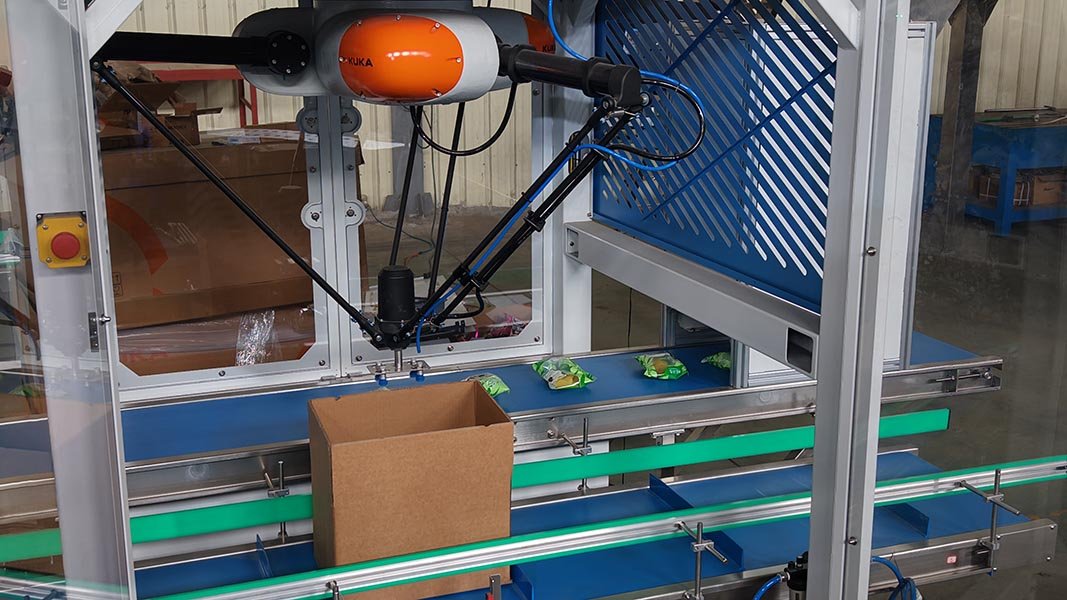
For a Delta robot, convert bag flow into picks. At 120 bags per minute, one bag per pick means 120 successful picks per minute. Two bags per pick means 60 picks per minute, provided the bags can be grouped and gripped reliably. Ask for the demonstrated rate with your bag, case, and pattern, including case exchange time.
Delta Robot or Drop Packer?
| Delta robot | Drop packer | |
|---|---|---|
| Loading method | Picks and places bags in the required position. | Groups bags and releases a row or layer into the case. |
| Consider when | Bag orientation varies, case patterns change, or placement needs tighter control. | Bags lie consistently flat, the case pattern is horizontal, and the product tolerates the transfer. |
| Test closely | Film grip, missed picks, picks per minute, and changeover. | Bag settling, drop height, product damage, and case fill. |
Bag style changes the infeed design. Pillow bags may bounce or rotate after VFFS discharge, so spacing and alignment may be needed before either packer. Premade pouches with zippers, spouts, or stand-up bases need their final case orientation checked. Upright pouches may require a cassette or side-loading step; laying them flat on the infeed does not solve the upright case pattern. Test filled bags, not empty samples.
How Much Accumulation Is Needed?
A buffer helps the VFFS keep running through a short interruption at the case packer. Size it for a defined stop:
Buffer bags = VFFS bags/min × stop time in minutes
At 100 bags per minute, a 15-second stop adds 25 bags. The usable buffer must hold those bags plus packs already travelling between machines. Bag size and spacing determine conveyor length; a transfer conveyor with no controlled holding space is not necessarily a buffer.
Check how long recovery takes. If the case packer can accept 120 bags per minute while VFFS continues at 100, its spare capacity is 20 bags per minute. Clearing 25 buffered bags takes about 75 seconds. If both machines run at 100 bags per minute, the backlog cannot clear without slowing the VFFS. Accumulation must also avoid crushing bags or losing their order and orientation.
Can One Case Packer Connect to Two VFFS Machines?
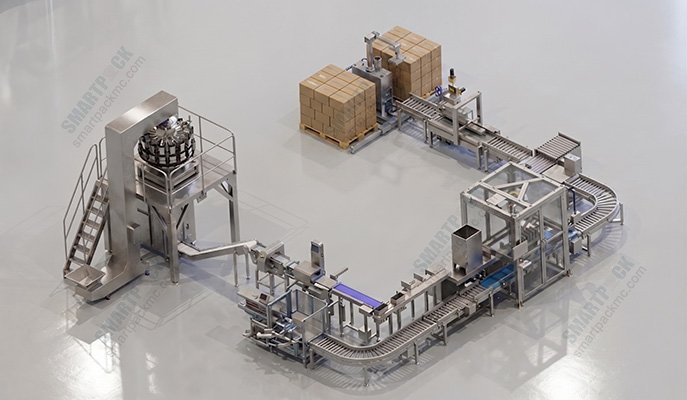
A shared system also needs a controlled merge. If the VFFS machines run different SKUs, the controls must track each bag to its case and prevent mixed cartons. Confirm what happens when one line stops, changes product, or sends a rejected bag while the other keeps running. Case supply and discharge must support the combined rate.
Match the Rest of the End-of-Line Equipment
The case erector must supply empty cases at the packer's required rate. The sealer, labeler, and case conveyor must handle its full-case discharge, including any faster run used to clear the bag buffer. Rate the palletizer in cases per minute for the actual stacking pattern, accounting for pallet exchange and any other lines sharing it.
Map where bags or cases can wait during a short downstream stop. Smartpack's end-of-line automation page shows the equipment that may need to be coordinated around the case packer.
Agree on the Stop and Restart Sequence
When the VFFS stops, the case packer can finish bags already on the conveyor. Its count must distinguish accepted bags from rejected ones. A partly filled case should be held under the same SKU and lot or removed under an agreed procedure before changeover; it must not leave as a full case.
When the case packer stops, the buffer fills. A high-level signal warns the line; a full-buffer signal requests a controlled VFFS stop before bags back up at its discharge. On restart, the controls confirm an empty case is available, account for bags in transit, and restore spacing. Specify these signals with the complete packaging line controls rather than leaving each machine to respond independently.
What Should FAT Cover?
Agree on the target rate, run duration, acceptable errors, and test materials before FAT. The test should include:
- Actual filled bags: Smallest and largest formats, light and heavy fills, and the most inflated or difficult bag. Check count, orientation, pick or drop success, damage, and case fit.
- Production film: Run it on the VFFS during an integrated FAT. For a packer-only FAT, supply filled and sealed bags made with each relevant film; surface slip and stiffness affect handling.
- Production cartons: Test each case size with the specified corrugated blanks and sealing tape or glue.
- Line interruptions: Reject a bag, stop the VFFS, stop the packer, fill the buffer, resume from a partial case, and run both VFFS machines together if they will share the packer.
Record accepted bags per minute, completed cases, missed bags, and damage by SKU. If the existing VFFS is absent from FAT, document which signals were simulated and repeat the live interface test at site acceptance.
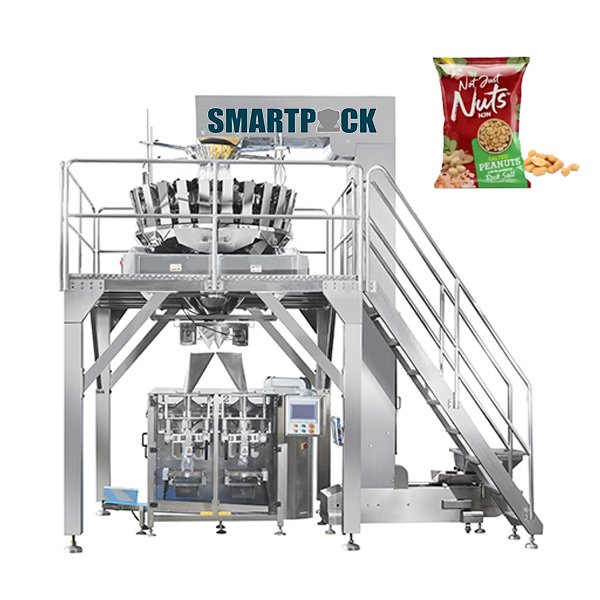
Send Smartpack the sustained and peak bag rates, filled-bag samples, bags per case, case drawings, and required packing pattern. Those details are enough to start comparing a Delta robot, drop packer, and the buffer each option needs.