

Are inaccurate product counts and frustrating line stoppages just a normal cost of doing business? They shouldn't be. Your current counting system could be quietly draining your profits.
The best counting system depends on your product. Traditional machines count items one-by-one, which is great for uniform products. Multihead weighers use weight to calculate quantity, offering superior speed and accuracy for irregular, sticky, or mixed items where traditional counters often fail.

For years, I've visited factories that rely on traditional counting machines for everything. They accept the daily jams, the constant adjustments, and the product giveaway as a normal part of business. But when I show them how a different technology can solve these exact problems, it's a game-changer. It's not about one machine being universally "better," but about using the right tool for the job.
Let's break down how each system works, so you can see which one is the right fit for your production line.
How Do Traditional Counting Machines Really Work?
Are you frustrated by inconsistent counts from your packaging line? These errors directly impact your profits. Understanding how your machine works is the first step to fixing the problem.
A traditional counter uses sensors to detect and count each item as it passes in a single file. It works like an automated version of counting by hand, relying on items moving one by one without touching or overlapping.
I remember visiting a gummy bear factory where the production manager was constantly fighting with their channel counter. The machine seemed to have a mind of its own. On paper, the concept is simple. Products are fed from a hopper onto vibratory channels that separate and line them up. As each individual piece falls past a sensor (often an optical eye), it gets counted. When the target count is reached, a gate closes, and the batch is dropped into the package. But reality is often more complicated. The entire system's success depends on perfect product separation, and that's where the problems usually start.
When Single-File Counting Fails
This one-by-one method has some built-in challenges, especially when products are not perfect.
- Sticky or Clumped Products: Items like gummies or coated nuts tend to stick together. When two pieces pass the sensor as one clump, the machine only registers one count, leading to underfilled bags.
- Irregular Shapes and Sizes: For products like mixed snacks or hardware, small pieces can get hidden behind larger ones, fooling the sensor. Or, irregular shapes can cause them to tumble and bounce, sometimes being counted twice or not at all.
- High Speeds: The faster you run the machine, the harder it is for products to form a perfect single-file line. This increases the chances of miscounts and jams, forcing you to slow down production to maintain accuracy.
Why is a Multihead Weigher a Smarter Counter for Some Products?
Are you packaging irregular or sticky products? Traditional counters struggle with these, causing jams and miscounts. There is a system designed to handle these challenging items with ease.
A multihead weigher doesn't count items individually. Instead, it uses "counting-by-weight." By knowing the average weight of one piece, it rapidly calculates the best combination of weights from multiple hoppers to achieve the target count with incredible precision.
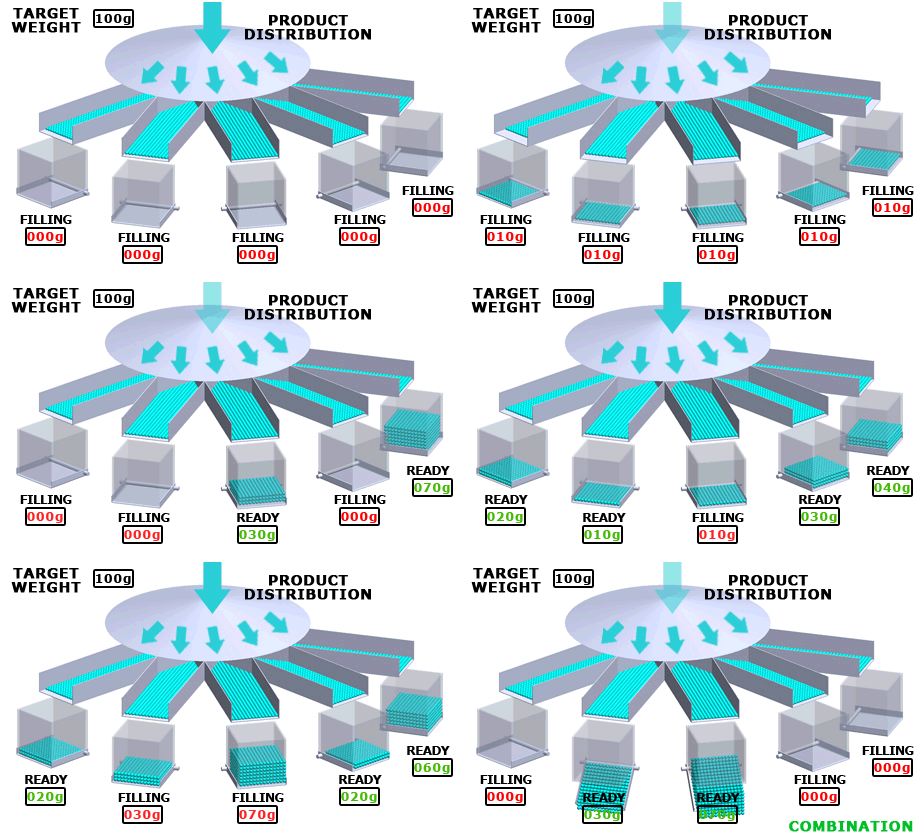
Instead of trying to force unruly products into a single line, we take a completely different approach. We bypass the one-by-one counting problem entirely. A multihead weigher, or what we call a combination weigher, has multiple weighing heads—typically 10 to 24. Product is fed to all heads. The machine's computer knows the weight in each head and instantly calculates which combination adds up to the perfect target weight, which corresponds to your target piece count. For example, if you need 50 pieces and each piece weighs 2 grams, the weigher will find a combination of heads that equals exactly 100 grams. This happens in a fraction of a second, making it incredibly fast and accurate. This method thrives on the very randomness that causes traditional counters to fail.
The Power of Combination
The magic is in the combinations. Let's see how this works for different products.
- Mixed Products: Imagine you're packing a trail mix with nuts, dried fruit, and chocolate pieces of all different sizes and weights. A traditional counter would be a nightmare. A multihead weigher handles this easily, as it's just looking for a total target weight.
- Fragile Items: For delicate items like premium crackers or certain biscuits, the gentle vibration and drop of a multihead weigher is much less likely to cause breakage compared to the forced channeling of a traditional counter.
- High-Value Products: When packing things like cannabis, pharmaceuticals, or high-end confectionary, accuracy is everything. Every overfilled bag is lost profit. The precision of counting-by-weight minimizes this giveaway significantly.
Which Machine Gives You Better Accuracy and Less Giveaway?
Is product giveaway eating into your margins? Even a small overage per bag adds up to huge losses over a year. Let's compare which machine protects your profits best.
A multihead weigher almost always delivers better accuracy and less giveaway than a traditional counter, especially for non-uniform products. Its combination weighing system actively finds the most precise weight, while counters are prone to plus/minus errors.

I worked with a snack company that was giving away, on average, 1-2 extra pretzels per bag. It didn't sound like much, but my calculations showed it cost them over $50,000 a year. Their channel counter simply couldn't be more precise. Because it counts in whole units, if a product's weight varies, the final bag weight can fluctuate significantly. In contrast, a multihead weigher's entire job is to minimize that variation. By using the average piece weight, it can get incredibly close to the target, ensuring that almost every bag is right on the money. This directly translates to less wasted product and more profit on your bottom line.
A Head-to-Head Accuracy Comparison
Let's look at a typical scenario to see the financial impact.
| Feature | Traditional Counter | Multihead Weigher (Counting by Weight) |
|---|---|---|
| Counting Method | One-by-one unit counting | Combination weighing based on average piece weight |
| Typical Error | +/- 1-2 pieces (or more) | +/- 0 pieces (targets precise weight) |
| Product Giveaway | High, especially with weight variation | Extremely low, often less than 1% of one piece |
| Consistency | Varies with product shape, speed, and stickiness | Highly consistent across almost all product types |
| Best For | Uniform, low-cost items where small overages don't matter | High-value products or where count accuracy is critical |
How Do You Choose the Right Counting System for Your Product?
Confused about which machine is the best investment? Making the wrong choice can lead to years of production headaches. The right decision comes down to understanding your product and goals.
Choose a traditional counter for simple, uniform, low-cost items that separate easily. For everything else—especially sticky, irregular, mixed, fragile, or high-value products—a multihead weigher offers superior speed, accuracy, and long-term ROI.
The final decision should be a business one. I always tell my clients to analyze their product first. Don't just think about what it is; think about how it behaves. Roll some on a table. Do they stick? Do they vary in size? Are they fragile? Then, think about your priorities. Is raw speed the only goal, or is reducing giveaway and minimizing downtime more important? We helped a vitamin manufacturer switch from a high-speed counter to one of our multihead weighers. Their bags-per-minute rate stayed about the same, but their overall daily output increased by 20% because we eliminated the constant stops and jams they were experiencing. Their accuracy improved so much that the machine paid for itself in less than 12 months from product savings alone.
Your Decision Checklist
Ask yourself these questions to find the right path:
- What is my product's profile? Is it uniform, hard, and easy to separate (like bolts or hard candy)? Or is it sticky, irregular, or fragile (like gummies, hardware kits, or snacks)?
- How important is accuracy? Is a giveaway of 1-2 pieces acceptable, or is my product high-value where every piece counts?
- What is my true speed requirement? Do I need the highest possible bags-per-minute, or do I need the highest overall equipment effectiveness (OEE) with minimal downtime?
- What are my future needs? Will I be packaging different products on this line in the future? A multihead weigher offers far more flexibility to handle a wider range of items than a dedicated counter.
Conclusion
Choosing the right system is critical. A multihead weigher often provides superior accuracy and uptime, especially for challenging products, delivering a fast return on your investment through reduced giveaway.
Partner with the Counting Experts at Smartpack
At Smartpack, we have extensive experience implementing multihead weigher counting solutions. We've successfully delivered many projects for complex applications, including mixed candy, sticky gummies, and premium snacks. If you are ready to achieve true count accuracy and maximize your profitability, contact our team. Let's find the perfect solution for your product.