

Small roasteries often waste thousands on wrong equipment choices. Limited budgets and space make every decision critical for survival.
Small roasteries need linear weighers (10-15 bags/minute) for entry-level operations or multihead weighers (30-45 bags/minute) for growth. Choose premade pouch systems for flexibility, VFFS for consistent high-volume production.
After helping over 300 small and medium roasteries choose their packaging equipment at Smartpack, I've seen how the right choice transforms businesses while the wrong one destroys them. Let me share the insights that will help you make the perfect decision for your roastery's success.
What Production Scale Defines Your Equipment Needs?
Understanding your actual production requirements prevents costly mistakes that plague many roasters. Most underestimate their needs or overestimate their budget capabilities.
Production volumes from hundreds to several thousand bags daily require different equipment approaches. Entry-level systems suit startups, while mid-range solutions support growing operations with 1,000-5,000 bags daily.
Last year, I visited a craft roaster in Portland who was packaging everything by hand. The owner was working 16-hour days just to meet orders from three local cafes. His hands were developing repetitive stress injuries, and he was turning down new business because he couldn't keep up. He needed equipment but had no idea where to start.
We analyzed his actual production together. He was filling about 200 bags daily by hand, taking roughly 2 minutes per bag including weighing, filling, and sealing. With just basic equipment, he could reduce that to 20 seconds per bag while improving consistency. The time savings would let him focus on roasting and business development instead of manual packaging.
Small roasteries face unique challenges that large producers don't encounter. Space is usually limited in urban facilities or shared production spaces. You might be operating in a converted garage, basement, or small industrial unit where every square foot matters. Equipment footprint becomes as important as capacity.
Budget constraints affect every decision. Unlike large producers who can finance million-dollar lines, small roasters often work with tight cash flow and need equipment that pays for itself quickly. The wrong choice can tie up capital for years without delivering adequate returns.
Product diversity is another factor large producers don't face. While industrial coffee companies might run the same bag size for weeks, small roasters often switch between 12-ounce retail bags, 2-pound wholesale sizes, and 5-pound bulk orders multiple times daily. Your equipment must handle this variety efficiently.
Which Entry-Level Systems Work Best for Startups?
Starting with appropriate equipment prevents expensive upgrades while building operational experience. Many new roasters either buy too much or too little equipment initially.
Linear weigher systems with premade pouches offer 10-15 bags per minute capacity, ±3 gram accuracy, and simple operation perfect for roasteries producing under 1,000 bags daily.
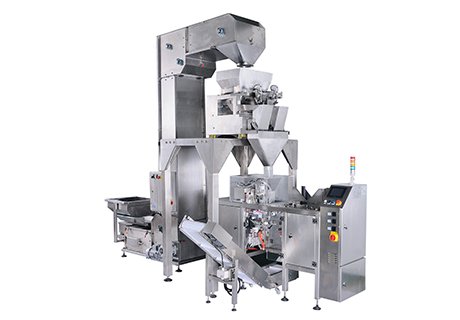
I remember working with a husband-and-wife team starting their first roastery in a 1,200-square-foot space. They had $25,000 for all packaging equipment and needed something that could grow with their business. Their initial production was just 150 bags daily, but they projected 500 bags within two years.
We recommended a linear weigher system with premade pouch capability. The machine fit in a 6-foot by 4-foot footprint, could handle their current volume easily, and would support their growth plans. The touch-screen controls were simple enough that both partners could operate it without extensive training.
Six months later, they called to report they were running 300 bags daily and the equipment was performing perfectly. The accuracy was consistent at ±2 grams, which reduced their product giveaway significantly compared to hand-weighing. More importantly, they could focus on roasting quality and customer service instead of spending hours on packaging.
Linear weigher systems excel for entry-level operations because of their simplicity. The weighing mechanism uses a single scale that measures each portion before dispensing it into the package. Operation is straightforward - set the target weight, load packaging materials, and start production. Most operators master the basic functions within a few hours.
These systems work particularly well with premade pouches because changeovers between different bag sizes are simple. Replace the pouch magazine, adjust the settings on the touchscreen, and you're running a different product within 15-20 minutes. This flexibility supports the diverse product lines that most craft roasters offer.
Maintenance requirements stay manageable for small operations without dedicated technical staff. Most components are accessible for cleaning and basic maintenance. When problems occur, diagnosis is usually straightforward because there are fewer complex systems to troubleshoot.
How Do Mid-Range Systems Support Growing Operations?
Growing roasteries need equipment that improves efficiency while maintaining flexibility. Mid-range systems bridge the gap between entry-level and industrial equipment.
Multihead weigher systems deliver 30-45 bags per minute with ±1.5 gram accuracy, reducing giveaway significantly while supporting production volumes of 1,000-5,000 bags daily for expanding roasteries.

A regional roastery contacted me because their linear weigher couldn't keep up with demand. They were running two shifts daily and still falling behind orders. Their biggest problem wasn't just speed - it was accuracy. Their ±3 gram accuracy was creating expensive overfill on premium coffees selling for $15 per pound.
We installed a 14-head multihead weigher system that transformed their operation. Production speed increased from 12 bags per minute to 38 bags per minute, but the accuracy improvement was even more valuable. The ±1.5 gram precision reduced their giveaway from 2.5% to 0.8%, saving over $40,000 annually in product costs.
Multihead weighers work by using multiple weighing hoppers that work together to achieve target weights. The system calculates thousands of combinations per minute to find the best match for each target weight. This parallel processing creates both speed and accuracy advantages over single-scale systems.
The technology particularly benefits operations with diverse product lines. Each product can have stored recipes with optimized settings for different bean densities, target weights, and package formats. Switching between a light-roasted Ethiopian single-origin and a dark French roast blend requires just selecting the appropriate recipe on the touchscreen.
Integration capabilities become important at this production scale. Mid-range systems can connect with upstream equipment like storage hoppers and conveyors, and downstream systems like case packers and labeling equipment. This connectivity supports workflow efficiency as production volumes increase.
VFFS systems also enter consideration at mid-range production levels. For roasters focusing on consistent package formats produced in larger batches, VFFS can offer material cost advantages and higher throughput. A VFFS system producing pillow bags or gusseted bags might achieve 35-50 bags per minute while reducing packaging material costs by 10-15% compared to premade pouches.
What Package Formats Best Serve Small Roastery Needs?
Package selection affects both customer perception and operational efficiency. The wrong choice can limit marketing opportunities or create operational bottlenecks.
Premade pouches offer maximum flexibility for diverse product lines with quick changeovers, while VFFS systems provide efficiency for consistent formats. Stand-up pouches dominate retail displays, flat pouches work for wholesale.
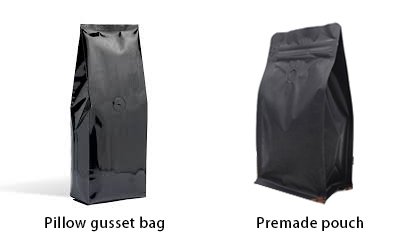
I worked with a roaster who was losing retail placement opportunities because their packages looked amateur compared to competitors. They were using plain pillow bags from their VFFS system while competitors had attractive stand-up pouches with one-way valves and resealable zippers.
We switched them to a premade pouch system that could handle multiple formats. They started using stand-up pouches with degassing valves for retail, flat pouches for wholesale, and zipper pouches for premium single-origins. Their retail presence improved dramatically, and they secured placement in two upscale grocery chains within six months.
Premade pouches excel for small roasters because of their flexibility. The same machine can run flat pouches, stand-up doypacks, pillow bags, and specialty formats just by changing the pouch magazine. This versatility lets you test new package styles without major equipment investments or long changeover times.
Stand-up pouches have become the dominant format in specialty coffee retail. They provide excellent shelf presence, maximize label area for branding, and offer structural integrity that maintains package appearance through distribution and display. Most include features like one-way degassing valves and resealable zippers that enhance product freshness and customer convenience.
VFFS systems work better for roasters with consistent, high-volume production of specific formats. If you're producing 2,000 identical bags daily, VFFS offers material cost savings and higher throughput. The continuous bag formation process typically uses 10-15% less packaging material than equivalent premade pouches.
However, VFFS changeovers take longer when switching between different bag styles or sizes. Changing from a 12-ounce pillow bag to a 2-pound gusseted bag requires replacing the forming tube, adjusting seal bars, and recalibrating the film feed system. This process can take 45-90 minutes compared to 15-20 minutes for premade pouch changeovers.
How Do You Calculate Equipment ROI for Your Roastery?
Financial analysis determines whether equipment investments make sense for your business. Many roasters focus on purchase price while ignoring total cost of ownership.
Calculate ROI by comparing labor savings, reduced giveaway, increased capacity, and quality improvements against total ownership costs. Equipment paying back within 12-24 months typically represents sound investment.
A small roaster came to me wanting the cheapest possible packaging solution. Their manual operation was costing them $3 per hour in labor just for packaging, plus 4% product loss from weighing inconsistencies. They were focused entirely on minimizing upfront costs.
We calculated the numbers together. Manual packaging was actually costing them $18,000 annually in labor and $24,000 in product giveaway - $42,000 total. An entry-level automated system costing $45,000 would eliminate most of these costs while increasing capacity. The payback period was just 13 months, and they would save money every year afterward.
Labor savings often provide the largest ROI component for small roasters. Manual packaging typically costs $2-4 per hour in direct labor, not including the opportunity cost of having skilled staff doing repetitive tasks instead of value-added activities like quality control or customer service.
Accuracy improvements deliver ongoing savings that compound over time. A 2% reduction in giveaway saves $200 per day on 1,000 bags with 500-gram target weights and $10/kg product cost. Over a year, that's $73,000 in savings - often enough to pay for the entire equipment investment.
Capacity increases enable business growth that manual operations cannot support. The roaster I mentioned earlier was turning down wholesale accounts because he couldn't meet minimum order quantities. Automated equipment let him accept larger orders and grow his business beyond what manual operations could support.
Quality improvements create less measurable but equally important benefits. Consistent weights, better seal integrity, and professional package appearance enhance customer satisfaction and brand reputation. These benefits are harder to quantify but often determine long-term business success.
What Implementation Strategy Minimizes Risk and Maximizes Success?
Proper implementation planning ensures equipment performs as expected while minimizing business disruption. Many roasters rush installation and create unnecessary problems.
Plan equipment installation during slower periods, invest in thorough training, establish maintenance schedules, and build strong supplier relationships for long-term success.
I remember a roaster who wanted to install new equipment during their busiest season because they needed the capacity immediately. Against my advice, they scheduled installation during Christmas week when their production was at peak demand. The installation took longer than expected due to facility issues, and they missed delivery commitments to several key customers.
Smart implementation starts with timing. Plan major equipment changes during slower periods when production disruptions have less impact. Most roasters have seasonal patterns - use these lulls for equipment installation, training, and optimization.
Training investment pays dividends throughout the equipment's life. Even simple machines perform better with properly trained operators who understand all functions and troubleshooting procedures. We typically recommend 8-16 hours of initial training plus follow-up sessions after operators gain experience.
Maintenance schedules prevent expensive breakdowns and extend equipment life. Establish daily, weekly, and monthly maintenance routines based on manufacturer recommendations. Simple tasks like cleaning, lubrication, and inspection prevent most equipment failures while maintaining warranty coverage.
Supplier relationships become critical for long-term success. Choose suppliers who provide responsive technical support, maintain parts inventory, and offer upgrade paths as your business grows. The lowest-price supplier isn't always the best choice if they can't support your operation effectively.
Conclusion
Match equipment capabilities to your specific production needs and growth trajectory. Entry-level linear weighers serve startups well, while multihead weighers support growing operations requiring higher accuracy and throughput.