

Your VFFS machine is running fast, but finished bags are piling up. You have a bottleneck, and it’s costing you efficiency, time, and money every single shift.
The end-of-line (EOL) layout for a Vertical Form Fill Seal (VFFS) line covers all processes after the bag is sealed. This includes inspection, case packing, and palletizing. A well-planned EOL system ensures that finished bags move efficiently from the packer to shipment-ready pallets.
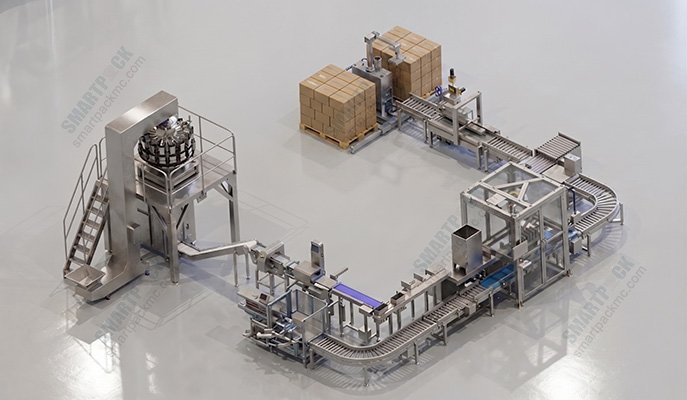
Getting your VFFS machine was a big step. You invested in speed and precision for your primary packaging. But I’ve seen many factories where that investment is held back by what happens after the bag is made. A high-speed VFFS machine is only one part of the puzzle. If you don't plan the rest of the line, you create a new bottleneck that chokes your overall output. The real goal is to get your products onto a truck, and that requires a smooth, continuous flow from start to finish. Let’s break down how to build the second half of your line correctly.
What Does “End-of-Line” Mean in a VFFS Packaging Line?
The term "end-of-line" sounds technical and maybe a little confusing. You might worry you are missing important steps in your production. But it’s actually very simple.
In a VFFS packaging line, end-of-line (EOL) refers to all the equipment and processes that happen after the primary bagging is complete. Its purpose is to get your sealed bags into cases and onto pallets for shipping, with minimal manual handling and maximum efficiency.
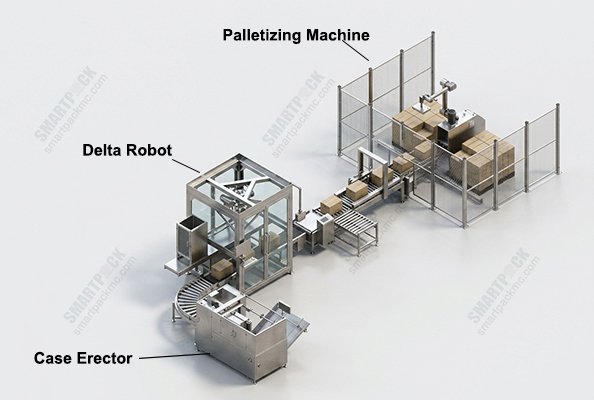
Think of your packaging process in a few major stages. We start with feeding your product, weigh or fill it, and then use the VFFS machine to create the primary package—the sealed bag. That's the end of primary packaging. Everything that comes next is "end-of-line." This is where we make sure the bags are the right weight, free of contaminants, and then prepare them for bulk shipment.
The main EOL stages are:
- Inspection: Checking bag weight and for metal contamination.
- Case Packing: Getting the bags into a secondary container, like a cardboard box.
- Palletizing: Stacking those boxes onto a pallet.
- Shipment Prep: Wrapping the pallet so it’s stable and ready for transport.
The simple goal of EOL automation is to connect these steps into a seamless flow. This reduces the need for people to manually handle, count, and stack bags, which is often where the biggest slowdowns and errors occur.
What is the Typical Equipment After a VFFS Packaging Machine?
You know you need more than just your VFFS machine to complete your line. But what are all those other machines for? Let's break down the key components.
Typical equipment after a VFFS machine includes a discharge conveyor, checkweigher, metal detector, case erector, case packer, case sealer, and palletizer. Each machine performs a specific task to move bags from the packer to a shipment-ready pallet automatically and efficiently.
When we design a complete line, we think about it as a single, integrated system. Each piece of equipment has a job to do, and it has to work perfectly with the machine before and after it. I remember a client who bought a very fast VFFS machine but didn't upgrade their manual packing station. The machine had to be run at half speed because the workers couldn't keep up. That's why understanding each component is so important. Here are the machines that make up a modern EOL system:
1. Checkweigher and Metal Detector
These are your quality control guardians. The checkweigher weighs every single bag to ensure it’s within your target weight range, automatically rejecting any that are too light or too heavy. The metal detector scans for any metal contaminants. We almost always place these before the case packer, so you don't waste time and money packing a defective bag.
2. Discharge Conveyor
This conveyor catches the finished bags as they exit the VFFS machine. Its main job is to transfer the bags smoothly to the next station. A good discharge conveyor also helps create a consistent gap between bags, preventing them from piling up and making them easier for the next machine to handle.
3. Case Erector
This machine automates a tedious manual task. It grabs a flat cardboard box, opens it up, and seals the bottom flaps with tape or glue. This creates a steady supply of perfectly formed, ready-to-load cases for the case packer.
4. Delta Robot
This is the heart of a high-speed secondary packaging process. We often use a Delta Robot, which is an incredibly fast and precise robot designed for pick-and-place tasks. It uses vision systems to see the bags coming from the collation system, picks them up, and gently places them into the open cases from the erector. This is ideal for fragile products like chips or for achieving very high throughput.
5. Case Sealer, Labeler, and Printer
Once the case is full, the case sealer closes and seals the top flaps. Right after, a labeler can apply a shipping label with barcodes, and a printer can add batch codes or production dates. This makes the case ready for warehouse inventory and logistics.
6. Robotic Palletizer
The final step. A robotic palletizer picks up the sealed cases and stacks them onto a pallet in a pre-programmed pattern. This is much safer and more consistent than manual lifting.
What are Common End-of-Line Layouts for VFFS Packaging Lines?
Choosing an EOL layout feels overwhelming, and picking the wrong one means you've wasted your investment. But it’s easier if you match the layout to your factory's specific needs.
Common EOL layouts range from basic manual packing tables for small operations to fully automatic, multi-line systems with robotic palletizing. The right choice depends on your production speed, budget, product type, and future growth plans, ensuring your EOL system supports your VFFS machine.
Over the years, we've installed hundreds of lines, and I've learned that there's no single "best" layout. The best layout is the one that solves your problem. It's about finding the right balance between automation, cost, and flexibility. To help you think through this, here are five common layouts we often recommend, from the most basic to the most advanced. Think about where your operation is today and where you want it to be in a few years.
Layout 1 — Basic VFFS Line with Manual Case Packing
- Typical Flow: VFFS Machine → Discharge Conveyor → Checkweigher → Manual Packing Table → Manual Case Sealing
- Best For: Small factories, low to medium output, limited budgets, and frequent product changeovers. This is the simplest setup, relying completely on manual labor for secondary packaging. Bags come off the VFFS and drop onto a packing table. An operator must then manually grab a flat box, open it, fill it with the correct number of bags, and then manually seal the case with a tape gun. It's flexible and has the lowest initial cost, but it's slow and entirely dependent on your operator's speed. As soon as your volume grows, this manual process will be your number one bottleneck.
Layout 2 — VFFS Line with Semi-Automatic End-of-Line Handling
- Typical Flow: VFFS Machine → Checkweigher / Metal Detector → Accumulation Conveyor → Manual Packing Station → Automatic Case Sealer
- Best For: Medium-speed lines, factories upgrading from manual packing, and companies wanting to reduce labor step-by-step. This is a practical and popular upgrade. An operator still performs the core tasks of manually opening the case and filling it with bags. However, once the case is full, they simply push it onto a conveyor that feeds into an automatic case sealer. This small automation step eliminates the tedious and time-consuming task of using a tape gun, which speeds up the process and improves the consistency of the final sealed case. It's a great middle-ground for growing operations that want to solve a key bottleneck without a full automation investment.
Layout 3 — VFFS Line with Automatic Case Packing
- Typical Flow: VFFS Machine → Inspection → Bag Alignment → Case Erector → Delta Robot pick and place bags in case → Case Sealer → Labeler
- Best For: High-speed lines for snacks, candy, nuts, frozen foods, and pet food. When your VFFS machine is running at high speed (e.g., 80+ bags per minute), manual packing is no longer an option. This layout automates the entire case packing process. A case erector builds boxes, and after alignment, a Delta Robot uses its vision system to pick up the bags and precisely place them into the carton. This layout ensures your EOL can keep up with your VFFS machine, delivering stable output. It's the key to unlocking the true potential of a high-speed line.
Layout 4 — VFFS Line with Case Packing and Robotic Palletizing
- Typical Flow: VFFS Machine → Inspection → Bag Collation → Case Erector → Delta Robot → Case Sealer → Robotic Palletizer
- Best For: Higher-output factories, long production runs, heavy cartons, and plants that want shipment-ready automation. This layout represents a nearly "lights-out" operation. After the Delta Robot packs the case and it's sealed, it’s conveyed directly to a robotic palletizer. The palletizing robot stacks the cases onto a pallet with perfect precision, eliminating the demanding and injury-prone job of manual palletizing. An integrated stretch wrapper can then wrap the finished pallet. This system is perfect for high-volume facilities that want to minimize manual handling from the bagger all the way to the warehouse.
Layout 5 — Multiple VFFS Lines Feeding a Centralized Palletizing System
- Best For: Large food factories, multi-line production, facilities with multiple SKUs, and centralized warehouse output. This is the next level of integration, building upon the principles of Layout 4. Instead of dedicating one palletizer to each line, multiple automated VFFS lines feed into a single, centralized robotic palletizing cell. This requires much more than just connecting conveyors. Our Smartpack team designs these systems to handle complex logic. We plan for things like how to maintain overall plant output even when one line is down for maintenance or a product changeover. We also focus on creating the most efficient conveyor paths to minimize the total factory footprint. This is a truly bespoke solution for large-scale operations focused on maximum efficiency and future flexibility.
How to Choose the Right EOL Layout Based on VFFS Speed?
Your VFFS machine is fast, but your whole line is still slow. The problem is that your EOL automation isn't matched to your VFFS output, creating a bottleneck.
The right EOL layout is directly related to your VFFS machine's speed. A line running at 40 bags/min has very different needs than one running at 140 bags/min. Matching your automation level to your output is crucial for avoiding downstream bottlenecks.
The speed of your VFFS machine is the most important factor when deciding on your EOL layout. As the bags per minute increase, the pressure on the downstream equipment grows exponentially. What is manageable for one person at 40 bags per minute becomes impossible for three people at 120 bags per minute. The goal is to create a balanced line where no single station is waiting on another. Here is a simple guide we use to help our clients determine the right level of automation based on their line speed.
| VFFS Output | Common Bottleneck | Recommended EOL Layout |
|---|---|---|
| 30–60 bags/min | Manual packing is still manageable. | Discharge conveyor + inspection + manual packing table |
| 60–100 bags/min | Manual carton loading becomes unstable and inconsistent. | Semi-auto system or automatic case sealing |
| 100–160 bags/min | Case packing becomes the main, unavoidable bottleneck. | Automatic case packing system |
| 160+ bags/min | Downstream coordination and carton handling are critical. | Automatic case packing + robotic palletizing |
| Multiple VFFS lines | Case flow and palletizing pressure on the dock increase. | Centralized case conveyor + central robotic palletizer |
This table serves as a great starting point. Looking at your target speed helps you immediately narrow down your options and focus on the layouts that will actually support your production goals, preventing you from either over-investing in automation you don't need or under-investing and creating a new problem.
What Key Factors Affect the End-of-Line Layout?
It’s not just about speed. I've seen customers choose a layout that looks perfect on paper but fails in reality because they overlooked a key detail about their product or factory.
Beyond speed, you must consider bag size and weight, bag type, product fragility, factory space, and your budget. These factors determine the specific equipment and configuration needed to create a layout that truly works for your operation.
Designing a successful EOL system is about getting the details right. A system designed for small, light bags of candy will fail spectacularly if you try to run heavy bags of pet food through it. Before we even draw a single line on a layout diagram, we ask our clients about these crucial factors. Thinking through them will help you avoid costly mistakes and ensure your line runs smoothly from day one.
Bag Size and Weight
Heavier bags require more robust conveyors and gripper mechanisms on case packers and palletizers. Larger bags also mean larger, heavier cases, which can influence everything from the case packer's design to the need for a robotic palletizer to avoid manual lifting injuries.
Bag Type
The shape and stiffness of a bag have a huge impact on how it handles. A flat, stiff quad-seal bag is easy to control. A soft, airy pillow bag of chips is much more challenging to stack neatly. Gusseted bags behave differently from simple sachets. The EOL system must be designed to handle your specific bag type.
Bags per Carton
This number, known as the pack pattern, directly impacts your EOL speed calculation. If you need to pack 24 bags per carton, your case packer has to work much faster than if you only pack 6. It also affects the collation equipment needed to group the bags correctly before packing.
Product Fragility
What's inside the bag matters. We have to handle a bag of fragile potato chips very differently than a bag of durable hardware. Gentle handling might require special conveyors and a case packer that places bags instead of dropping them, which impacts equipment choice and cost.
Factory Space
This is a simple reality we can't ignore. The perfect layout is useless if it doesn't fit in your building. We always have to work within the available floor space, considering not just the machines themselves but also room for operators to work, for maintenance access, and for forklift traffic.
Automation Budget
Your budget determines your level of automation. The good news is that EOL automation is scalable. You can start with a semi-automatic layout to solve your most immediate bottleneck and plan to add a case packer or robotic palletizer in a later phase as your business grows and your budget allows.
Future Expansion
A great layout today should not become a dead-end tomorrow. We always ask: What are your plans for the next five years? Do you plan to add another VFFS line? Will you introduce new products or bag sizes? A well-designed layout leaves room for future growth, making it easier and cheaper to expand later.
What's a Good Example Layout for a Snack VFFS Packaging Line?
Theory is great, but you want to see how this applies to a real-world factory like yours. Let's look at a common application: packaging snacks.
For a high-speed snack line (chips, nuts, pretzels), the ideal EOL layout focuses on gentle handling and continuous throughput. It typically includes a checkweigher, bag alignment system, automatic case packer, and robotic palletizer to match the VFFS speed and protect the fragile product.
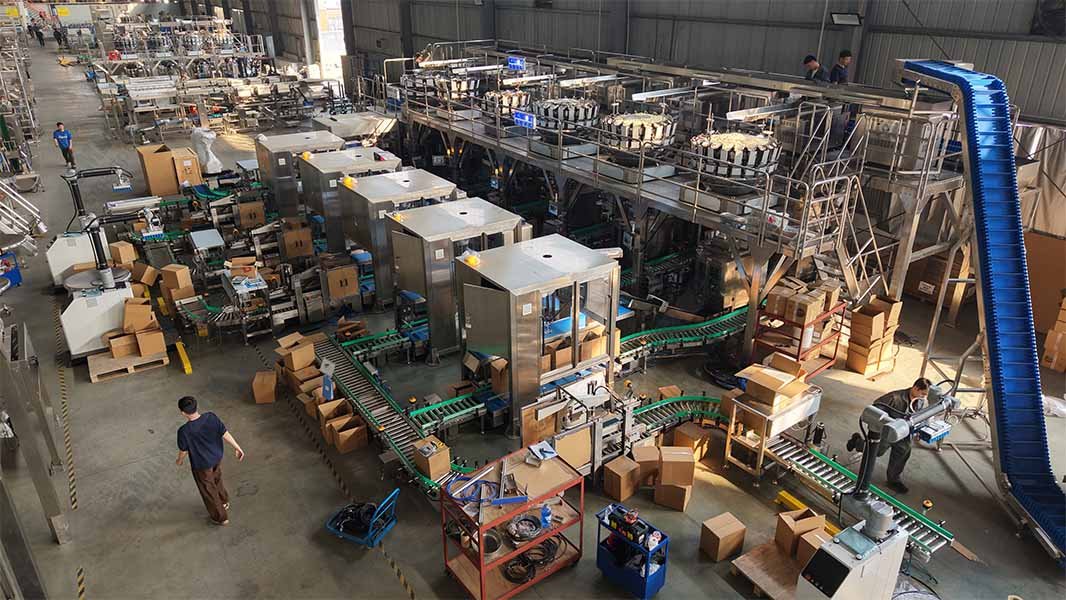
When we work with snack manufacturers, speed and product protection are the top priorities. The VFFS line is often running very fast, and the products inside the bags are fragile. If your case packing area still relies on manual labor, you will face constant problems with bag accumulation, inconsistent output, and product damage. This is a classic case where manual packing becomes the primary bottleneck, limiting the entire factory's output.
A well-designed EOL layout for this application would be Layout 3 or 4:
- Primary Line: Multihead weigher + VFFS packaging machine
- Recommended EOL Layout:
- Discharge conveyor to receive finished bags gently.
- Checkweigher and Metal Detector for quality control.
- Bag alignment conveyor to control direction and spacing for the packer.
- Case erector to prepare cartons automatically.
- Automatic case packer (often a "pick and place" style) to gently load bags into cartons.
- Case sealer and Labeler to prepare cases for shipping.
- Robotic palletizer to stack cartons safely and consistently.
- Stretch wrapper to secure the pallet for shipment.
This fully automated system ensures that the end of the line can keep up with a high-speed VFFS machine, maintaining line efficiency and protecting the quality of your fragile snacks from bagging to palletizing.
Why Is Speed Matching Important in a VFFS EOL System?
You bought a VFFS machine rated for 120 bags per minute. But when you look at your total output, you're only shipping enough product for 80 bags per minute. What happened?
The problem is almost always a speed mismatch. Your entire packaging line is only as fast as its slowest component. If your case packer or palletizer can't keep up with your VFFS machine, the VFFS machine will be forced to stop and wait, destroying your overall efficiency.
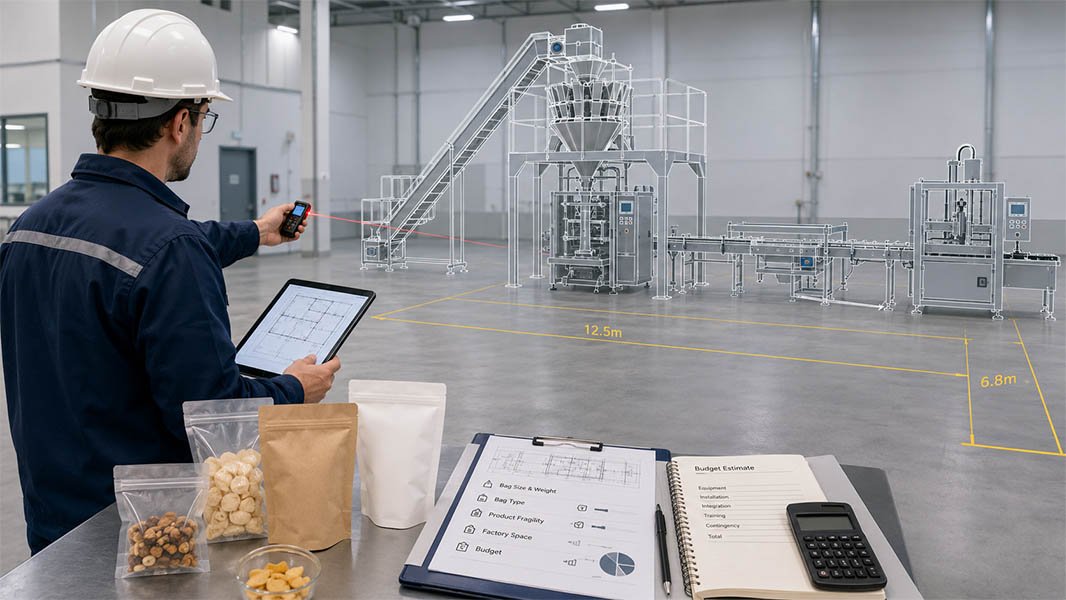
This is one of the most common and costly mistakes I see people make. They focus only on the speed of the VFFS machine. A balanced line is a profitable line. We must calculate the required speed for each piece of equipment in the EOL system to ensure there are no bottlenecks. The calculation is simple but powerful.
Let's use an example:
- Your VFFS machine runs at 120 bags per minute.
- Your pack pattern is 24 bags per carton.
The calculation for your case packer is:
Bags per minute ÷ bags per carton = required cases per minute 120 ÷ 24 = 5 cases per minute
This means your case erector, case packer, and case sealer must all be able to handle a minimum of 5 cases per minute, continuously. If you buy a case packer that can only handle 4 cases per minute, your VFFS machine will be forced to stop every few minutes. The same logic applies to the palletizer. You have to calculate the cases per minute and pallet pattern to ensure it can keep up. A good EOL layout is always designed as a complete, balanced system.
How Does Smartpack Design VFFS Packaging Lines with End-of-Line Automation?
Trying to piece all these machines together from different suppliers is daunting. You risk ending up with compatibility issues and a system that doesn't work as a single unit.
At Smartpack, we design and deliver complete, turnkey packaging lines. We take responsibility for the entire system, from the product feeder to the final palletizer, ensuring every component is perfectly integrated to meet your specific goals for speed, efficiency, and product handling.
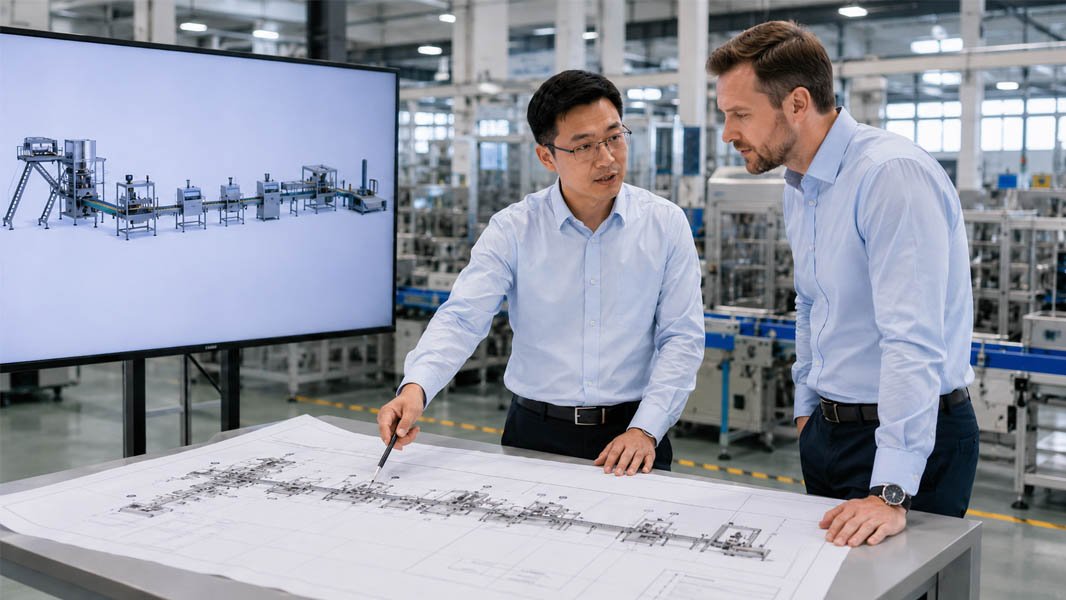
We believe you shouldn't have to be a packaging integration expert. That's our job. When you partner with us, we look at your entire process. We start with your product, your bag, your carton, and your factory. Then, we design a complete line that delivers the performance you need. We have over a decade of experience and more than 1000 successful installations, so we know what works.
Our turnkey VFFS lines can include:
- Feeding systems
- Multihead weighers (including models for sticky, frozen, or fragile products)
- VFFS packaging machines
- Checkweighers and metal detectors
- Case erectors
- Automatic case packers
- Case sealers and labeling systems
- Robotic palletizers
We customize the layout and equipment for your specific application, whether you're packaging snacks, candy, nuts, frozen food, pet food, powders, or granules. We manage the project from design to installation, providing you with a single point of contact and ensuring a seamless, efficient system that just works.
When Should You Upgrade from Manual EOL to Automatic EOL?
You're managing with manual packing for now, but you can see the problems piling up. You have bags accumulating, your staff looks tired, and packed cases are inconsistent.
You should upgrade to an automatic EOL system when manual labor can no longer keep up with your VFFS machine's output. The key signs are bag accumulation, inconsistent packing quality, rising labor costs, and the need to run longer, more stable shifts.
Making the jump to automation is a big decision, but there usually comes a point where it’s not just an option, it's a necessity for growth. I tell my clients to walk their factory floor and look for the signs. If you see any of these issues, it's time to have a serious conversation about upgrading your end-of-line process.
Ask yourself these questions:
- Are your operators visibly struggling to keep up with the speed of the VFFS machine?
- Do finished bags constantly accumulate on a table or in a bin after the machine?
- Is the quality of your packed cartons inconsistent, with some being too loose or overstuffed?
- Is manual palletizing of heavy boxes causing safety concerns or staff turnover?
- Is the rising cost of labor making it hard to stay profitable?
- Do you need to run longer shifts or add a night shift to meet demand?
- Are your shipping cartons or pallet patterns unstable, leading to issues in the warehouse or with customers?
- Are you planning to add more VFFS lines in the near future?
If you answered "yes" to one or more of these, then the cost of not automating is likely higher than the investment to upgrade.
Conclusion
A VFFS line is much more than just the bagging machine. A well-planned end-of-line layout is essential for turning your VFFS machine's speed into real, shippable output.
Send Smartpack your product type, bag size, target speed, carton format, and factory layout. Our team can help design a suitable VFFS packaging line from weighing and bagging to case packing and palletizing.