

Your primary packaging is fast, but manual case packing creates a bottleneck. This slows down your entire line, increases labor costs, and risks inconsistent final packaging.
End-of-line automation connects your entire process, from the primary package to the final pallet. It automates conveying, case packing, and palletizing. This eliminates bottlenecks, reduces labor dependency, and ensures your output speed matches your primary packaging machine's capability, transforming your line's efficiency.
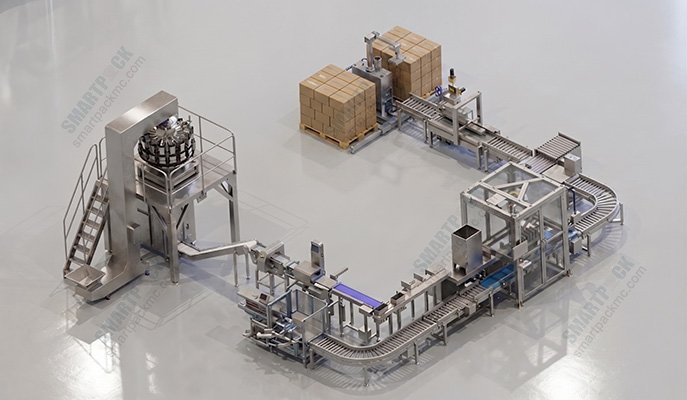
You see the problem and the potential solution. But what does this automation actually involve? It's more than just buying a robot. It's about building a complete, integrated system. I've seen countless factories struggle because their filling machine is world-class, but everything after it is pure chaos. I've helped hundreds of manufacturers make this transition, and I'm here to guide you through it so you can create one continuous, efficient flow.
What Exactly Is End-of-Line Automation?
You hear the term "end-of-line," but it seems complex and expensive. Without a clear definition, you risk investing in mismatched equipment that doesn't solve your core problem of a disjointed line.
End-of-line automation refers to the system of machines that takes over after your product is in its primary package. It handles everything from conveying and grouping to case packing and palletizing, creating a seamless flow for secondary and tertiary packaging.
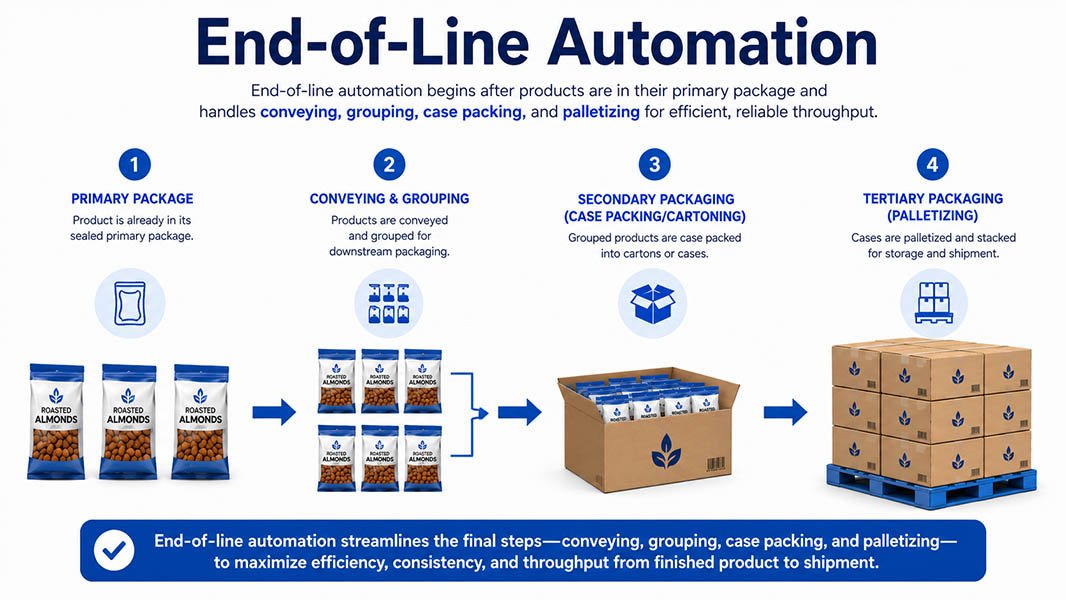
Let's dive a little deeper. Many people I talk to think of automation as just one machine. But in reality, true end-of-line automation is about making several stages of packaging work together as one cohesive system. I remember a client who bought a state-of-the-art case packer, but didn't account for how the bags would get there from his VFFS machine. The result? Operators were still manually collecting and arranging bags, defeating the purpose. You have to think about the entire journey of the package.
Here’s a simple breakdown of the packaging stages:
| Packaging Stage | Description | Examples |
|---|---|---|
| Primary | The package that directly touches the food. | A pillow bag for chips, a tray for a ready meal, a jar for nuts. |
| Secondary | Groups primary packages for handling or retail. | A small carton holding 10 snack bars, a master case for 12 bags of frozen vegetables. |
| Tertiary | Prepares grouped packages for shipping. | A shrink-wrapped pallet of cases. |
End-of-line automation seamlessly connects these stages, taking your sealed bag, tray, or jar all the way to a shipping-ready pallet.
What Key Equipment Makes Up an Automated End-of-Line System?
Picking the right machines can feel overwhelming. With so many options, you might choose something that isn't right for your product, wasting time and money on a system that underperforms.
A typical system includes conveyors for collation, delta robots for high-speed picking, cartoning machines for retail boxes, and case erectors and packers for shipping cases. The system finishes with sealing, labeling, inspection, and often a robotic palletizer.
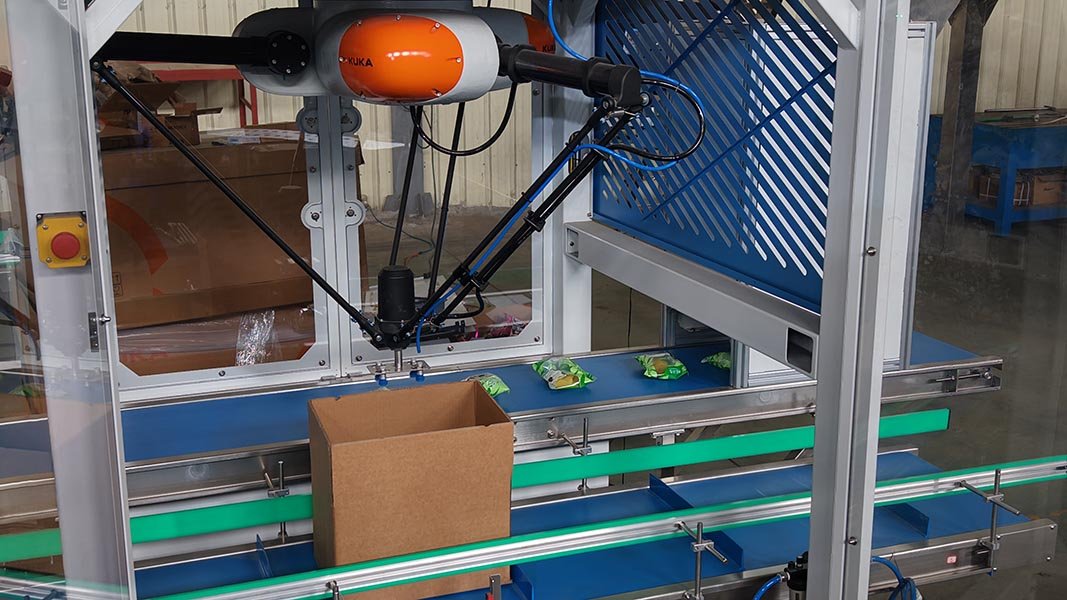
The magic is in how these pieces connect. I’ve seen factories where the case packer can’t keep up with the primary packaging machine, creating a huge backup. A well-designed system avoids this. It starts with getting the product ready for the next step.
Product Conveying and Collation
This is the unsung hero of the line. Before a robot or case packer can do its job, your finished packs need to be transferred, spaced, and arranged correctly. A bag might need to be flattened, a tray turned, or a jar aligned. Many case packing problems I troubleshoot don't start at the case packer; they start with an inconsistent flow of products arriving at it.
High-Speed Pick-and-Place
This is where machines like Delta robots shine. They are perfect for picking up lightweight items like snack bags, candy, or clamshells from a moving conveyor and placing them precisely into a carton or case. Their flexibility allows you to change packing patterns or products with software, not with a wrench.
Case Erecting, Packing, and Sealing
This is the core of secondary packaging. A case erector forms flat boxes, a case packer loads your products, and a sealer closes the case with tape or glue. After that, integrated labelers and inspection systems like checkweighers ensure every case is correct and ready for shipment.
Should You Choose Mechanical or Robotic Case Packing?
You need a case packer, but which type? Choosing the wrong one can lock you into an inflexible system that can't adapt to new products, costing you future growth opportunities.
Use mechanical case packing for high-volume, single-product lines with little variation. Choose robotic case packing for flexibility. It's ideal if you handle multiple SKUs, various pack patterns, or delicate products that require gentler handling and quick changeovers.
This is a decision I help clients with all the time. There isn't a single "best" answer; it depends entirely on your operation. A mechanical case packer often uses guides, pushers, and drop-gates. It can be incredibly fast and efficient, but only if you're packing the same product in the same way, day in and day out. Changeovers can be time-consuming.
Robotic systems, like those using a delta robot or a larger articulated arm, are champions of flexibility. I worked with a snack food company that introduced three new bag sizes in one year. Their old mechanical packer couldn't handle it. Switching to a robotic system allowed them to program new patterns in minutes, not hours, and handle the different products without any mechanical adjustments.
Here’s a quick comparison to help you think it through:
| Factor | Mechanical Case Packing | Robotic Case Packing |
|---|---|---|
| Flexibility | Low; best for single SKUs. | High; easily adapts to new products/patterns. |
| Changeover | Slow, often requires tools. | Fast, often done through software. |
| Product Handling | Can be rough. | Gentle, good for delicate items. |
| Initial Cost | Generally lower. | Generally higher. |
| Footprint | Can be more compact. | Can require more space for safety cells. |
How Do You Choose the Right End-of-Line System for Your Needs?
You're ready to invest, but where do you start? Without a clear plan, you could end up with a system that doesn't fit your space, your speed, or your future goals.
Start by defining your product, package type, and required speed. Then, map out your case packing patterns and consider SKU changeover frequency. Finally, evaluate your factory space and plan for future growth before selecting any specific machinery.
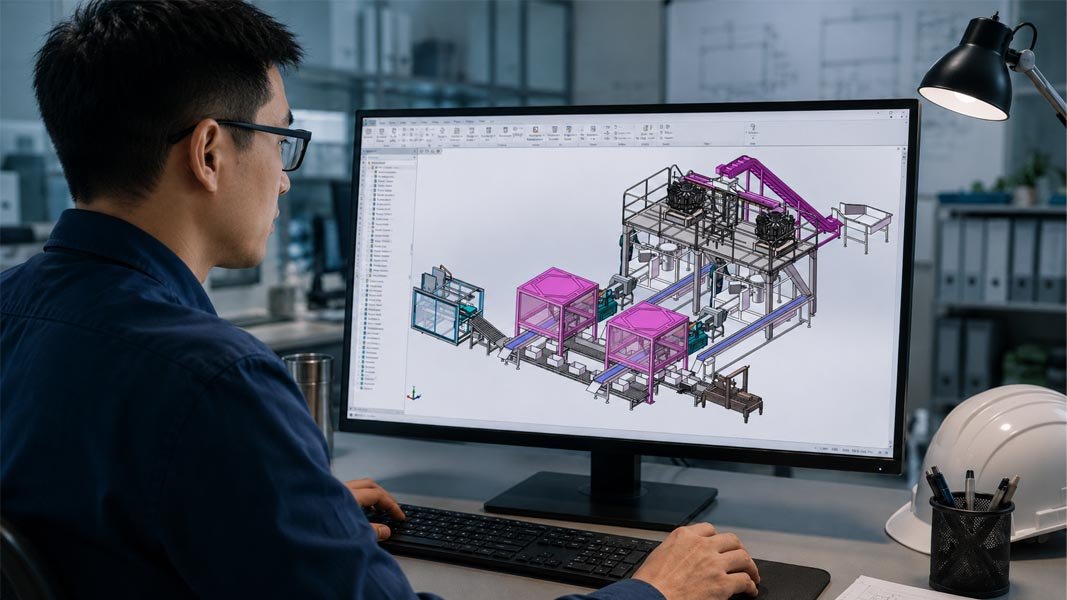
Don't start by asking which machine is fastest. Start by understanding your real needs. At Smartpack, we walk our partners through a detailed process to avoid costly mistakes.
1. Define Your Product, Package, and Speed
The first step is always the product. Is it a light pillow bag? A heavy jar? A fragile clamshell of berries? This determines everything. We also need to know your primary packaging machine's speed. Your end-of-line system must be able to keep up, or you've just moved the bottleneck.
2. Map Out Your Case Patterns
How do you need the products arranged in the case? Standing up? Lying flat? In layers? A line for snack bags (VFFS → collation → case packing) will be completely different from a line for ready meals in trays (Tray sealer → checkweigher → cartoning → case packing). We have to design for the final pattern.
3. Factor in Flexibility and Space
How many different products or case sizes will you run on this line? The more variety, the more you should lean towards flexible, robotic solutions. You also have to be realistic about your floor space. We have to design a layout that works in your factory, including all the necessary conveyors and safety guarding.
Conclusion
Upgrading your end-of-line process eliminates manual bottlenecks and creates a truly automated system. This ensures consistent, efficient production from start to finish, boosting your overall output and profitability.