

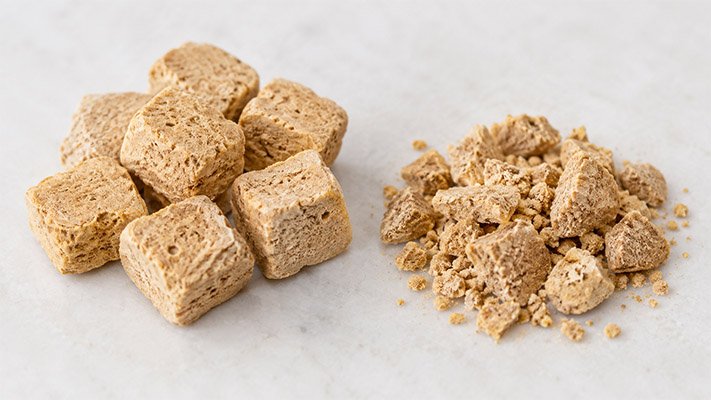
Freeze-dried pet food is lightweight, porous and often more fragile than conventional kibble. Meat cubes, patties, strips and meal toppers can crack during feeding, weighing or pouch filling, creating powder and small fragments that reduce shelf appeal and perceived product value.
Reducing breakage is therefore not simply a matter of slowing down the packing machine. Every transfer point—from the product feeder to the final pouch—must be evaluated.
Protecting freeze-dried pet food requires controlling the complete product path, not only the final packing step.
This guide explains where damage commonly occurs, how gentle-handling equipment can reduce impact and what should be tested before selecting a freeze-dried pet food packaging machine.
Why Freeze-Dried Pet Food Breaks During Packaging
Freeze-drying removes moisture while maintaining the product’s internal structure. The finished pieces may look solid, but their porous structure can crack under vibration, impact or compression.
The risk varies considerably between products. Small freeze-dried granules may flow relatively well, while large chicken cubes, fish pieces or mixed recipes may have irregular shapes and different levels of hardness.
The following factors usually increase breakage:
- Excessive vibration during product feeding
- High drops between connected machines
- Sudden hopper opening and discharge
- Long or steep chutes that accelerate the product
- Pieces colliding inside an overfilled hopper
- Narrow filling tubes or pouch openings
- Product striking the zipper area during filling
- Frequent machine starts, stops or product accumulation
A low target weight does not always make the application easier. Freeze-dried pieces have a low bulk density, so a 50 g portion can occupy much more space than 50 g of ordinary kibble. Hopper volume, discharge width and pouch opening may therefore be more important than the nominal target weight.
| Transfer Point | Common Cause of Breakage | What to Check |
|---|---|---|
| Product feeding | Product is dumped too quickly or from excessive height | Feeding rate and initial drop |
| Elevator discharge | Pieces hit the receiving hopper or collide with each other | Outlet position and discharge speed |
| Weigher feeding pans | Vibration is stronger than the product requires | Flow stability and visible cracking |
| Hopper discharge | Sudden release causes pieces to hit hard surfaces | Gate speed, opening sequence and cushioning |
| Discharge chute | A long or steep chute accelerates the product | Chute angle, length and surface |
| Pouch entry | Pieces strike the zipper or pouch mouth | Opening width, positioning and filling timing |
Finding the exact damage point is essential. Modifying the pouch machine will not solve a problem caused by an unsuitable elevator or excessive vibration above the weigher.
Build a Gentle Feeding and Weighing Path
Control Product Feeding Before Weighing
A stable flow is usually gentler than repeatedly sending large batches into the weighing system. The feeder should deliver enough product to maintain production without overloading the multihead weigher.
Important design considerations include:
- Controlling the speed of the elevator or feeding conveyor
- Reducing the distance between the feeder outlet and the weigher
- Using level sensors to prevent overfeeding
- Positioning the outlet so that pieces do not strike the center plate directly
- Avoiding repeated start-stop movements and sudden product surges
- Selecting a feeding structure based on piece size and fragility
Slowing every machine is not automatically the best solution. An excessively slow feeder can create interruptions, accumulation and repeated machine starts. The objective is controlled, continuous movement with fewer hard impacts.
Large cubes or irregular pieces may require a customized conveyor, wider outlet or reduced transfer height. A standard bucket elevator designed for durable granules may not be suitable without modification.
Configure the Weigher for Fragile Pieces
A standard multihead weigher can handle some freeze-dried products, but its operating parameters and product-contact structures may need to be adapted.
A gentle-handling configuration can include:
- Lower and independently adjustable vibration
- Optimized radial feeder length and angle
- Shorter distances between feeding and weighing hoppers
- Food-grade cushioning on selected contact surfaces
- Controlled hopper-gate opening speed
- Wider discharge openings for large pieces
- A gradual discharge chute rather than a steep free fall
- Larger hoppers for lightweight, high-volume portions

The number of weighing heads should not be the only selection criterion. A higher-head-count weigher may provide more available weight combinations, but it will not solve restricted product flow, undersized hoppers or excessive impact.
Product-contact parts should also be easy to remove. Small fragments and powder can accumulate around feeder pans, hopper gates and discharge chutes, so accessible cleaning is important for both hygiene and stable operation.
A standard high-speed multihead weigher may not suit unusually large pieces or products that cannot tolerate repeated vibration. Depending on sample-test results, a modified multihead weigher, belt-fed system or semi-automatic solution may be more appropriate.
Reduce the Final Drop Into the Pouch
The product can still be damaged after accurate weighing. The distance between the weigher discharge and the bottom of the pouch is often one of the longest drops in the system.
To reduce this risk:
- Shorten the total discharge path where the layout allows
- Use a gradual or segmented chute
- Avoid narrow filling tubes that restrict large pieces
- Confirm that the pouch is fully opened before discharge
- Select a pouch opening that accommodates the product dimensions
- Synchronize the weigher discharge with pouch positioning
- Consider controlled or staged discharge for bulky portions
For premade zipper pouches, the filling path should guide the product beyond the zipper without striking it. A reliable pouch-opening device is also important because a partially opened pouch can cause impact, blockage or product loss.

Premade Pouches or VFFS: Which Is Better?
Both premade pouch machines and vertical form fill seal machines can pack freeze-dried pet food. The better option depends on the product, package positioning, required output and acceptable packaging cost.
| Factor | Premade Zipper Pouch Machine | VFFS Machine |
|---|---|---|
| Packaging material | Higher cost per premade pouch | Lower roll-film cost |
| Brand presentation | Well suited to premium products | Suitable for standard and high-volume packs |
| Resealability | Zippers are widely available | Requires additional configuration |
| Product entry | A wide opening can accommodate large pieces | Forming-tube diameter must be selected carefully |
| Typical products | Premium cubes, treats and meal toppers | More uniform, higher-volume products |
| Main breakage risk | Product strikes the zipper or pouch mouth | Long drop or restricted forming tube |
Premade zipper pouches are often selected for premium freeze-dried products because they provide strong shelf presentation and convenient resealing. Their wider opening can also help accommodate large pieces.
VFFS can offer lower packaging-material costs and higher production potential. However, the forming tube, bag width and total filling distance must be matched to the product. A narrow forming tube can cause pieces to collide, rotate or become blocked.
Package dimensions should be based on product volume as well as weight. Two freeze-dried recipes with the same target weight may require different pouch widths or gussets because their piece sizes and bulk densities differ.
Nitrogen flushing may support freshness and control the atmosphere inside the package, but it does not directly prevent mechanical breakage. Impact still needs to be controlled through feeding, weighing and discharge design.
For a broader comparison of suitable systems, see How to Choose the Right Pet Food Packaging Machine.
Balance Speed, Accuracy and Product Integrity
Increasing vibration or feeding speed may raise output, but it can also increase collisions. Large pieces may need more time to enter and leave the hoppers, while bulky portions may require a longer filling cycle.
Actual output can be affected by:
- Product dimensions and bulk density
- Target weight
- Hopper capacity
- Pouch dimensions and opening time
- Discharge distance
- Acceptable breakage level
- Weigher and pouch-machine synchronization
A mechanical maximum speed does not represent verified production performance.
Ask for tested packs per minute, weight deviation and product-integrity results under the same test conditions. Higher output has limited value if it produces visibly damaged pieces or excessive powder.
How to Test Breakage Before Buying a Machine
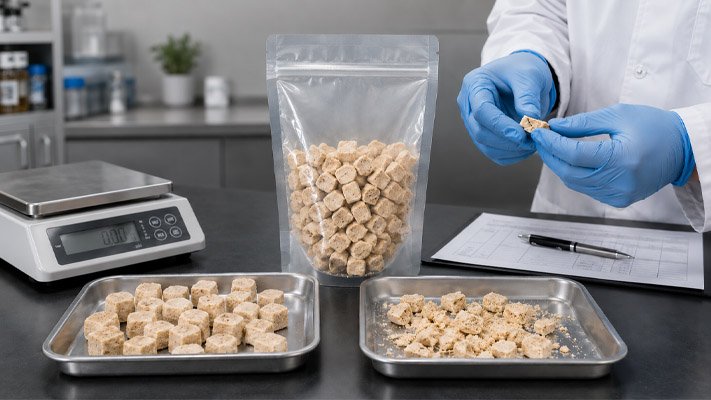
Representative product samples should be tested through the complete proposed system. Testing only the packing machine or running a few isolated weighing cycles may overlook damage elsewhere in the product path.
A practical test process should include:
- Record the original piece dimensions, shapes, density and visible fragments.
- Define what the customer considers a broken piece.
- Confirm the target weight and actual pouch dimensions.
- Run continuous feeding, weighing and packaging cycles.
- Collect finished packs from the beginning, middle and end of the test.
- Inspect whole pieces, fragments and visible powder.
- Record actual output, weight results and pouch-filling performance.
- Adjust vibration, gate timing, chute design or discharge height.
- Repeat the test and compare the results.
- Provide a test video and recommended configuration.
| Test Item | Information to Record |
|---|---|
| Product | Chicken, beef, fish or mixed recipe |
| Piece dimensions | Actual length, width and thickness range |
| Target weight | Required weight per pouch |
| Pouch size | Width, length, gusset and zipper opening |
| Weighing system | Weigher model and gentle-handling features |
| Test quantity | Number of completed cycles or pouches |
| Actual output | Verified packs per minute |
| Weight result | Average and maximum deviation |
| Product integrity | Whole pieces, broken pieces and visible powder |
| Adjustments | Changes to vibration, gates, chute or drop height |
| Final result | Verified outcome after adjustment |
If no breakage limit has been agreed upon, a supplier should not claim a specific reduction percentage. The acceptance method must be defined before the final test.
Information to Provide Before Requesting a Solution
To prepare an appropriate proposal, provide the machine supplier with:
- Pet food recipe and clear product photos
- Minimum and maximum piece dimensions
- Product bulk density
- Target weight range
- Current breakage problem
- Definition of an unacceptable broken piece
- Pouch style, size and zipper requirements
- Required output at each target weight
- Nitrogen-flushing requirements
- Existing feeding and downstream equipment
- Representative samples for testing
SmartPack can evaluate this information as part of a complete pet food packing machine solution rather than selecting the pouch machine independently.
Frequently Asked Questions
Can a multihead weigher handle freeze-dried pet food?
Yes, but the configuration should reflect the size, density and fragility of the pieces. Vibration, hopper capacity, gate movement, cushioning and discharge height may all require adjustment. A standard high-speed configuration is not suitable for every freeze-dried product.
Is a premade pouch machine better than VFFS?
Not in every application. Premade zipper pouches are attractive for premium products and can provide a wider filling opening. VFFS is usually more economical for higher-volume production, but the forming tube and drop height must be designed for the product.
Does nitrogen flushing prevent freeze-dried pieces from breaking?
No. Nitrogen flushing is primarily used to manage the atmosphere inside the package. Mechanical breakage must be addressed by controlling vibration, impact, drop height and product movement.
Can one machine pack different freeze-dried recipes?
It may be able to handle several recipes, but each product should have its own operating parameters. Different piece dimensions and densities can require changes to vibration, hopper timing, pouch size or filling speed. Cleaning and cross-contamination requirements should also be considered during changeovers.
Conclusion
Reducing freeze-dried pet food breakage requires more than choosing a machine described as “gentle.” The complete product path must be reviewed, including feeding, weighing, hopper discharge, chute design and pouch entry.
The most reliable selection process follows three principles:
- Identify every transfer point where impact may occur.
- Balance output and weight accuracy with product integrity.
- Verify the proposed configuration using the actual product and package.
Send SmartPack your product samples, piece dimensions, target weights and pouch specifications. Our engineering team can test the feeding, weighing and filling process and recommend a configuration based on observable production results.