

The customer needed more than a standalone powder filler. Empty cans had to be fed, UV-treated, turned, given a measuring scoop and filled automatically. Each filled can then needed a second weight check, capping, another turn and final collection.
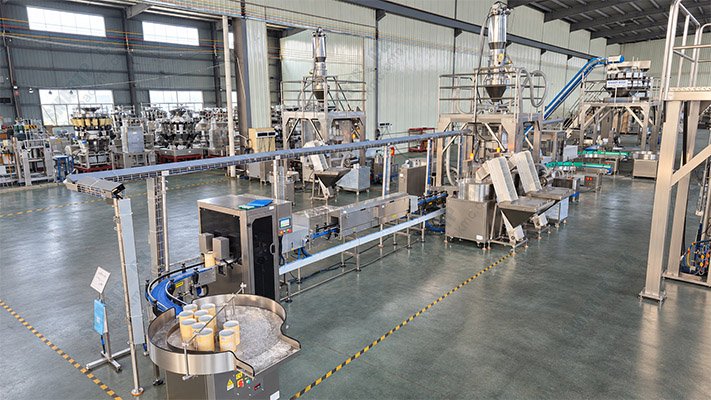
Smart Weigh built these operations into one automatic jar and can packing system. It handles cans from 99 to 127 mm in diameter and target weights from 230 to 840 g. The complete line runs at 30–40 cans per minute, with filling accuracy controlled within 0.5–1% under the agreed production conditions.
From an Empty Can to a Finished Whey Protein Pack
The line begins with automatic empty-can feeding. Instead of asking an operator to place cans onto the conveyor one by one, the feeding section supplies them continuously and keeps enough distance between them for the following stations.
UV treatment is one part of the hygiene plan, not a replacement for sanitation throughout the production area. For products sold as dietary supplements in the United States, the FDA’s current good manufacturing practices for food and dietary supplements also cover equipment, sanitary operations and production controls.
Once UV treatment is complete, the cans are turned into the correct position for packing. They then move to the scoop feeder, where one measuring scoop is dropped into each can. The powder is weighed according to the selected recipe and filled on top of the scoop.
Each filled can then passes over an online checkweigher. Only after this second weight check does it continue to the capping station. The closed cans are turned once more and transferred to the finished-product collection area.
The full process is:
- Automatic empty-can feeding
- UV sterilization
- Can turning
- Automatic scoop insertion
- Powder weighing and filling
- Checkweighing
- Capping
- Second can turning
- Finished-can collection
Why the Cans Are Turned Twice
Can turning looks like a minor part of the line, but it affects whether the container arrives at the next station cleanly and in the right position.
The first turning device is installed after UV treatment. It brings the empty can into the upright position required for scoop insertion and powder filling. Because this project covers can diameters from 99 to 127 mm, the turning section and conveyor guides must be adjusted for each can format. A narrow can and a wide can cannot simply run through the same guide setting.
The second turning device is placed after capping. It returns the sealed can to the orientation required for collection or the customer’s next packaging step.
Both turning points are connected to the conveyor controls. If a can is not released properly, the following station should not continue feeding scoops, powder or lids as though everything were normal.
The Scoop Goes In Before the Powder
There are two common ways to add a measuring scoop: place it into an empty can before filling or add it after the powder has already been filled.
For this line, the scoop is inserted first. The powder then falls over it and keeps it inside the container. This avoids pushing a scoop into a full can, which could compress the powder or leave the handle close to the can rim.
The scoop feeder must match the actual scoop rather than only its overall length. Its bowl shape, handle width, thickness and feeding direction all affect whether the scoops separate reliably. Before production, Smart Weigh tests the customer’s scoop together with the real cans instead of assuming that one feeder setting will suit every design.
Can detection is also tied to scoop release. The feeder only needs to discharge when a can is correctly positioned below it, preventing loose scoops from dropping directly onto the conveyor.
Filling 230 g and 840 g on the Same Line
The fill range in this project is wide. An 840 g dose needs considerably more powder than a 230 g dose, so the two formats will not always run at the same output.
For a lighter fill, the weighing and discharge cycle can normally be completed faster. With the 840 g format, more powder has to reach the weighing unit, settle and discharge into the can. Powder bulk density also matters. Two whey protein products can have the same net weight but occupy different volumes inside the filling system.
This is why Smart Weigh confirms which target weight will be produced most often. The line settings can then be optimized around the main format, while the speed of the other weights is tested separately.
The 30–40 cans per minute quoted for this project refers to the working speed of the complete line. The exact result depends on the selected fill weight, can size and flow behavior of the customer’s whey protein powder.
Keeping Powder Away from the Can Rim
Whey protein powder is light and can become dusty while being transferred. If the can is not centered below the filling outlet, part of the dose may land on the rim instead of inside the container.
That causes more than a housekeeping problem. Powder left around the top of the can can interfere with the following capping process and create unnecessary cleaning stops.
The conveyor therefore has to hold the can in a repeatable position during filling. The powder feeding and filling configuration must also suit the actual formulation. Changes in flavor, bulk density or flowability can affect both dust levels and filling speed, even when the target weight stays the same.
Testing with the customer’s real powder is the only reliable way to finalize these settings.
Why We Weigh Every Can Again
The powder filling unit already controls the dose, but the customer wanted another weight check before capping. An online checkweigher was therefore installed immediately after filling.
The checkweigher measures the complete can, including the container, scoop and powder. For each product format, an acceptable weight range is set using the known tare weight and required powder quantity. Cans outside that range can be identified before they are closed.
This does not replace accurate filling. It gives production another checkpoint. If several cans begin moving close to the upper or lower limit, operators can check the powder supply and filling settings instead of waiting until the deviation becomes more obvious.
The checkweigher also makes final inspection continuous. There is no need to stop the line and move occasional cans to a separate scale simply to confirm whether the filling section is still running within the agreed tolerance.
The accepted limits should follow the destination market’s requirements. For packages sold in the United States, NIST Handbook 133 explains how declared net contents are checked.
Line Speed Is Decided by More Than the Filler
It is easy to quote the maximum speed of the filling machine and treat that as the output of the whole project. In practice, the cans also have to be turned, receive a scoop, pass over the checkweigher and enter the capper without building up on the conveyor.
For that reason, Smart Weigh looked at the cycle of every station when setting the 30–40 cans-per-minute output. The scoop feeder must be ready before the next can arrives. The checkweigher needs enough separation between two cans to obtain a stable reading. The filling and capping equipment must accept the incoming cans without repeatedly asking the upstream machines to stop.
This coordination is what turns several machines into one usable production line.
What We Need to Test Before Building a Similar Line
Can diameter and target weight are a good starting point, but they are not enough to finalize a protein powder can filling system. Smart Weigh also asks for:
- Can height, material and opening dimensions
- Lid samples and capping requirements
- Scoop samples and the required placement direction
- The powder’s bulk density and flow behavior
- All target weights, with the main production size clearly marked
- Required output for each important format
- Acceptable weight tolerances
- Factory layout and preferred conveyor direction
- Any labeling, coding, metal detection or case-packing requirements
For the factory acceptance test, the best approach is to run the customer’s actual powder, cans, lids and scoops together. This reveals issues that drawings alone cannot show, such as a scoop that does not separate cleanly, a can that becomes unstable during turning or a powder formula that needs a slower discharge setting.
This whey protein powder line was designed around the complete container journey, not just the filling station. From UV treatment and scoop insertion to the final weight check and capping, each section follows the same production rhythm. That is what allows cans in the 99–127 mm range and fills from 230 to 840 g to be handled on one coordinated line.
If you are planning a similar project, contact Smart Weigh with your powder information together with the can, lid and scoop samples. Our engineering team can check the format range, filling method, layout and expected output using the products you actually intend to run.
SEO title: Whey Protein Powder Can Filling Line for 230–840 g Cans
Meta description: A whey protein powder can filling line for 99–127 mm cans and 230–840 g fills, covering UV sterilization, scoop insertion, checkweighing and capping at 30–40 cans per minute.